New York Medical School Dean Values His Student Experience at Rutgers
David Battinelli, a 1983 graduate of the University of Medicine and Dentistry of New Jersey (UMDNJ), now known as the Rutgers New Jersey Medical School, says his medical school experience as a student in Newark influenced his approach to leading medical education. He is coauthor of the new book Revolutionizing Medical Education: A Proven Blueprint to Transform Curricula and Prepare Future-Ready Physicians.
All signs pointed to David Battinelli becoming a doctor. His mother was a nurse at Mount Sinai Hospital in New York City, across the street from where he grew up. His father owned several flower shops throughout Manhattan, and Battinelli helped out by making deliveries to patients.
“Looking out the window or walking around the neighborhood, that’s all I saw: a hospital and people coming and going—nurses, workers, patients, and ambulances,” says Battinelli, dean of the Donald and Barbara Zucker School of Medicine at Hofstra/Northwell and Executive Vice President and Physician-in-Chief of Northwell Health. “The family joke is I didn’t really know there was another type of job.”
As an academic discipline, medicine appealed to him as an ideal blend of science and humanities, with the cognitive side of problem solving and the human aspect of dealing with patients. After completing high school at St. Peter’s in Jersey City and earning his bachelor’s degree from the University of Scranton in Pennsylvania, he returned to New Jersey and to attend the Rutgers University New Jersey Medical School—which, when Battinelli enrolled, was known as the University of Medicine and Dentistry of New Jersey (UMDNJ).
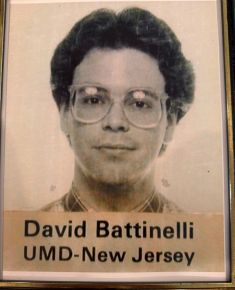
In many ways, it was a traditional medical school, he says, with large lecture halls where students learned various disciplines, piece by piece. But they also rotated through University Hospital in Newark, as well as other hospitals, where future physicians could experience a more meaningful role in patient care than at a private institution.
“You learned how to do everything—you were an active learner in the clinical world,” Battinelli says. “While UMDNJ was traditional for its time, the resources of the urban environment and strong faculty committed to the mission of a city hospital were its greatest strength—the combination of a university backbone, as well as a city hospital and a VA hospital.”
That experience as a student, he says, continues to inform his leadership in medical education.
“We got to do a lot and see patients and be on the front lines, which was not the case in many other medical schools.”
Revolutionizing Medical Education
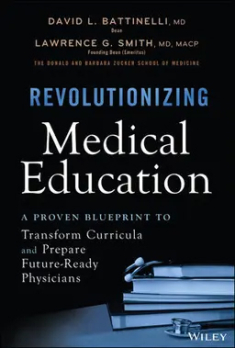
This April, 43 years after Battinelli earned his medical degree, Wiley published Revolutionizing Medical Education: A Proven Blueprint to Transform Curricula and Prepare Future-Ready Physicians, which Battinelli coauthored with Lawrence G. Smith, founding dean emeritus of the Zucker School of Medicine.
The book details their transformative approach to creating a new medical school—one that has attracted visiting faculty and administrators from more than 50 medical schools worldwide—while challenging educators, clinicians, and thought leaders to fundamentally rethink how to prepare tomorrow’s physicians.
“A great medical school affords you the opportunity to make sure that you can enjoy learning so that you continue to learn for the rest of your life,” Battinelli says. “We teach people to love to be students, and to love to learn, and help them compete against a standard of excellence and not each other.”
A new chapter for the school where Battinelli earned his M.D. is on tap when NJMS unifies with the Robert Wood Johnson Medical School (RWJMS) in New Brunswick as the future Rutgers School of Medicine. The pending accreditation of the new school is anticipated in 2027.
We Want to Hear from You
Are you an alumna or alumnus from one of Rutgers University’s medical schools? These include the legacy medical schools—such as the University of Medicine and Dentistry of New Jersey (UMDNJ) and the Rutgers Medical School—as well as the current Rutgers Robert Wood Johnson Medical School and the Rutgers New Jersey Medical School. If so, please update your contact information and let us know about your career.