From Rutgers Football to National Security to a Decorated Federal Law Enforcement Career
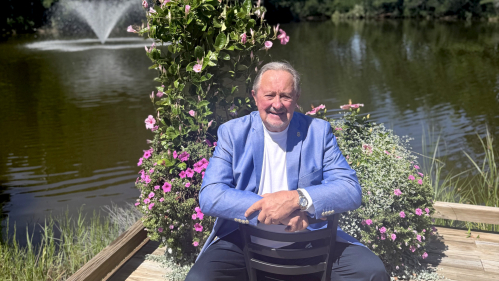
Dennis Dutch learned on the Rutgers football field that playing defense meant anticipating the next move and standing fearless in the face of pressure. He carried those lessons through 47 years of defending his country as a federal agent and investigator, dealing with national security, organized crime, arson, bombings, and corruption.
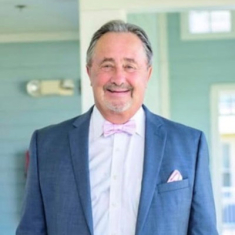
Playing football for Rutgers taught Dennis “Denny” Dutch to be proactive and fearless, skills he used through his career as a U.S. special agent and as a contract special investigator.
Dutch saw a lot: outlaw motorcycle gangs, arson, bombing, drug trafficking, organized crime, and white-collar collusion. He also handled national security issues and helped protect presidents Gerald Ford, Jimmy Carter, Ronald Reagan, and George H.W. Bush.
“When I was doing these things, it didn’t strike me as being dangerous because I had the protection of my law enforcement brothers,” he said. “After it was over, friends would ask, ‘Weren’t you scared?’ I said no because from playing Rutgers football, I was coached to play with reckless abandon, because I had my teammates, and that’s what I had with the job, too.”
Dutch grew up in Monongahela, Pennsylvania, a small town outside Pittsburgh where football was more than a game, it was a way of life. His family’s paper boy was legendary NFL player Joe (or “Joey,” as they called him) Montana. The son of a steel worker and grandson of a coal miner, Dutch was a good student at Monongahela High School and a noteworthy football player. He had signed to play at another large university, but once Rutgers showed an interest, he immediately accepted their offer, drawn to its “good balance and strength in athletics and academics.”
And that, he says, was the best decision he ever made in his life.
“It was Camelot for me, a brotherhood,” says Dutch, who was in the fraternity Delta Kappa Epsilon, primarily consisting of football players. “I grew up at Rutgers. It taught me about life.”
Though Dutch was a top high school student, Rutgers was a different ball game. In 1967, while his fraternity brothers gathered at the television to watch the first Super Bowl, Dutch was at the library.
“I learned to compete there—it gave me a sense of what it meant to work hard,” he says. “I was just an average student at Rutgers, but I made it. I entered a boy and left, I think, a little bit of a man. Rutgers exposed me to big city life and taught me not to wait for the ship of life to come in, but to swim to the boat—to be proactive, not reactive.”
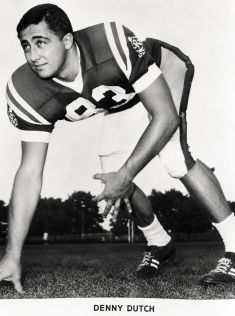
When Dutch arrived at Rutgers in 1965, freshman football was separate from varsity, and 140 men tried out on the first day for football. By the time he graduated, only 14 were left.
He first was a defensive end, but during his junior year, “for whatever reason, for the things I did in practice, they made me a defensive tackle.” That year he was named the most valuable defensive player against Delaware, he says, earning what they called “the Monster Award,” even though at 215 pounds, he was playing against players much bigger.
Law and Order
In a career spanning 1971 through 2018, Dutch spent 11 years as a special agent with the Bureau of Alcohol, Tobacco and Firearms (ATF), then 18 years as a special agent with the U. S. Department of Transportation Office of Inspector General. He retired in 2000, then spent 18 years as a contractor with the Department of State as a special investigator conducting security clearance background investigations.
ATF hired Dutch in Philadelphia as an undercover special agent, with his first assignment in the wake of a bombing at a munitions plant: to infiltrate the anti-war movement and identify protestors who posed a threat of violence. To blend in, he grew a beard and acquired a false identity, car, and apartment, and attended anti-war meetings, even sleeping in church pews with them.
“I was part of a human chain that surrounded the Harrisburg courthouse,” Dutch says. “I think 135 of us were arrested for interfering with the trial of the Berrigan brothers, American Catholic priests Daniel and Philip Berrigan who were prominent peace and antiwar activists.”
Then about a month later, his career as an undercover agent abruptly ended. While he was circulating a Communist Party petition in Center City Philadelphia, a former Rutgers football player came up to Dutch and called him by his real name, not his undercover name, in front of fellow protestors.
“That was dangerous, so I walked off after turning the petition over to my fellow protestors,” he says. “I reported it to the office, and I was taken off the assignment due to the potential danger it posed.”
In his next assignment, he investigated outlaw motorcycle gangs, one of which placed a contract on him and his family. When he arrived home one Friday night, he says he found his partner sitting outside his house, waiting to put Dutch and his family under protective custody. Another new ATF agent spent his first weekend as in Dutch’s dining room with a shotgun.
“On Monday, the special agent-in-charge contacted the gang’s president and said to him, ‘My club is bigger than your club,’ and they removed the contract,” Dutch says. “That encouraged me to move on to another career. I was OK with handling myself, but when my family was brought into the mix, it was time to stop and evaluate what was important in life.”
Dutch says he also investigated a prominent businessman and politician who was convicted in a federal jury trial for arson fraud.
“The key witness was Jimmy Hoffa’s Lewisburg prison bodyguard, an admitted organized crime contract killer of nine persons, who admitted to the arson, along with ‘Vinnie the Torch,’ a professional arsonist,” he says.
Another investigation involved a man who was arrested with an “assassination kit—a briefcase containing a handgun with an obliterated serial number, a silencer, a mask, several fake Kentucky driver’s licenses, and $20,000 cash.”
Dutch says, “He was the bodyguard of the largest cocaine trafficker in the country who was under indictment where the federal judge had been assassinated. He had been offered the contract to assassinate the judge on the case but refused. He later was convicted in federal court.”
Off the Street Beat
Leaving street crime, Dutch went into white collar crime “where the subjects wore suits and ran companies doing business with Uncle Sam.” Now with the Department of Transportation’s Office of Inspector General, he investigated road contractors who colluded to take turns winning government road contract bids.
“The problem is that with a rigged bid, taxpayers are paying more for roads than they should have, had they been bid truly competitively,” he says. “The commerce was a hundred billion of taxpayers’ dollars a year, nationwide, and it had gone on for decades.”
His investigation covered three states where he was credited with dozens of federal indictments and millions in recoveries. One state saved approximately $100 million because of his investigations where he was lead agent.
After teaching proactive investigations nationwide, he was called to Washington as special assistant to the Inspector General, a presidential appointee, to lead an international program involving unapproved aircraft parts, which were potentially serious airline safety issues. This assignment earned him the Silver Star, he says, the second highest award in the department of more than 10,000 employees.
In a letter to Dutch when he retired in 2000, Inspector General Kenneth M. Mead wrote, “You dedicated your career to federal law enforcement, first with ATF, and then with DOT OIG, and you can be proud of your accomplishments for a job well done.” Mead directed “that the badge number of Supervisory Special Agent Dennis Dutch is retired and is never again issued to a Special Agent for the DOT OIG.”
As a State Department investigator, he held top-secret security clearance and conducted security clearance background investigations for foreign service officers, which frequently took him to the White House and Capitol Hill, working with the CIA and the Pentagon. Dutch says he volunteered for an assignment to Baghdad to evaluate security procedures for the newly built U.S. embassy because the U.S. was trying to enlist the IraqI National Police to help provide embassy security.
“We quickly learned it was not a good fit to include the Iraqis, since a few years later, insurgents, including Iraq National Police members, attempted to storm and overthrow the embassy,” he says. “Was it dangerous? Well, we were transported in and out of the embassy grounds via Blackhawk gunships, and we left the embassy in a convoy of armored vehicles.”
Finally retiring for good in 2018, Dutch is now a self-proclaimed “snowbird,” spending his time between his home in Naples, where he announces high school basketball, and in Delaware, where he works in a golf shop.
“It was never a job for me, it was a vocation, a calling,” he says, “and we were told in training we were ‘doing God’s work.’ It was quite a ride.”
Support The Edge Fund
Please consider a gift to support the next generation of thinkers and creators whose achievements in art, sports, science, and technology redefine excellence.