Rutgers Shapes ‘Commitment to Helping Others’
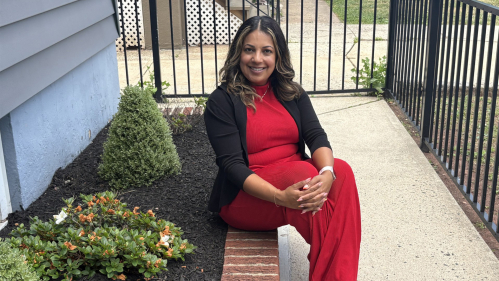
Alumna triumphs over personal tragedy to help victims of domestic violence.
Maliha Janjua understands what domestic violence victims go through because she was one herself — surviving a headline-grabbing shooting at a central Jersey mall while a student at Rutgers–Newark.
She has made it her life’s work to help victims of domestic violence at Women Aware, a nonprofit agency offering domestic violence services in Middlesex County.
While she was an undergraduate, close to finishing her undergraduate degree, she worked part-time at a retail store in a mall, where a coworker introduced her to a friend, a man whom she started dating. The man had told her that he planned to join the military and was leaving shortly for training.
Janjua, who says she noticed a few red flags, tried to terminate the relationship at a meeting at a public park where the man broke her phone and stole her wallet. “He had become very toxic and abusive, and he threatened me,” she says, noting that she was unaware “that ending an abusive relationship is the most dangerous time.”
Afterward, she went to the police but left without filing a restraining order. He started stalking her at work. A few weeks later, the man showed up at her job when she was not there and brought a couple of friends with him.
Her manager gave her the phone number for Women Aware. “I remember texting my best friend that he’s not going to stop until I’m in the hospital,” she says.
Not long after that, he returned to the store when she was working, pulled out a handgun, and shot at her five times at point-blank range, striking her once in the face and once in the arm. “Then he turned the gun around and killed himself,” she says.
Support from Rutgers
That was 19 years ago. “It took me many years to not feel guilty for what happened,” Janjua says.
Rutgers supported Janjua and her family throughout the ordeal, she says, adding that her parents and sister spoke to the university, which refunded her tuition and said that when she was ready, she could come back.
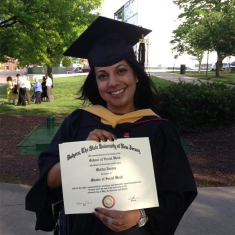
She returned to Rutgers–Newark, finished her degree, graduated, and then she went to the Rutgers School of Social Work in New Brunswick for her master’s degree.
“In hindsight, do I want to go back and change things that happened?” she says. “Of course, but I also understand that the reason that I have this deep empathy for the survivors whom I work with is because I was there.”
Janjua considers herself a survivor. “I am a triumphant survivor who was able to take my power back and thrive in the same community I almost died in,” she says. “My life’s work is to create safer pathways for survivors to our community.”
Hers is not an isolated case. There are 5,000 reported assaults each year in Middlesex County, which translates to 13 a day, she says, adding “domestic violence is grossly under-reported.” In New Jersey, there were 70,828 domestic violence incidents reported by the police in 2023, a 5 percent increase compared to the 67,512 reported in 2022.
Rutgers Prepared Her
She also credits her education at Rutgers University, a double major with an undergraduate degree in sociology and English from the School of Arts and Sciences–Newark, and her master’s degree from the School of Social Work in New Brunswick, for “shaping both my professional competence and my commitment to helping others.”
Her Rutgers education prepared her “with a strong clinical foundation grounded in evidence-based practice, cultural humility, and social justice,” says Janjua, director of client services for Women Aware. “It helped me develop the critical thinking, assessment, and therapeutic skills necessary to work effectively with individuals and families.”
In addition, Janjua says the knowledge and training she received enable her to build meaningful relationships with clients, provide compassionate trauma-informed care, and confidently navigate complex clinical situations. “Rutgers also emphasized the importance of advocacy and interdisciplinary collaboration, which have been invaluable throughout my career,” she says.
The graduate of Cardinal McCarrick High School in South Amboy, New Jersey, lived in Carteret for many years before moving to Woodbridge, where she now lives with her husband, a police officer, and two sons. She was born in Pakistan and moved to the United States when she was three years old.
A Career in Supporting Survivors
After graduating from her undergraduate program, she began working at St. Peter’s University Hospital in New Brunswick as a coordinator in the security department. She then came to work at Women Aware as a per diem caseworker, and later as a full-time caseworker in 2010.
She worked several positions at Women Aware, including senior counselor at the shelter, domestic violence liaison advocate and consultant dealing with high-risk domestic violence cases, and supervisor of the PALS Program, the children’s art therapy program.
I am a triumphant survivor who was able to take my power back and thrive in the same community I almost died in. My life’s work is to create safer pathways for survivors to our community.
Maliha Janjua
Women Aware assists about 11,000 individuals annually and houses about 180 families at its shelter. It has a staff of 29 people working at its main office and its shelter in Middlesex County, which provides safe housing for survivors and their children who are fleeing abuse. “Everyone’s story is unique or different,” Janjua says, adding she spends a lot of time helping domestic and dating violence victims and their families, and is happy that she can be a part of their journey and witness their strength to heal. Women Aware also operates the Middlesex County Family Justice Center, a one-stop shop for legal advocacy, counseling, healthcare navigation, housing support, and services for children.
“I have the privilege to witness their stories,” she says. “And I can be a bridge to get them from one point to another.”
It is up to the clients to realize that they need the help, and then Janjua helps guide them, she says.
Rutgers Pride
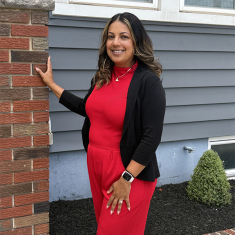
Janjua says she also appreciates that Rutgers is such an inclusive university. “I'm Pakistani American, and I grew up in a Muslim home,” she says. “I went to Rutgers–Newark, and there were many people who looked like me and from other backgrounds, and I was able to learn about different cultures, learn about cultural humility, being in that environment at Rutgers.”
Looking back at her years at Rutgers, Janjua says she has so much pride in her education. “We are in New Jersey, and we are spoiled,” she says. “Students from around the country and around the world go to Rutgers, and Rutgers is an excellent school.”
Janjua’s brother Junaid Janjua, a financial professional, received his undergraduate degree from the School of Arts and Sciences at Rutgers–New Brunswick in 2012 and his MBA from Rutgers Business School in Newark in 2016.
“Just walking around the campus, there is a vibe that you get just being around the other students,” she says. “If you are a Rutgers student, you very much have this pride, which is infectious.”
Women Aware is committed to helping individuals experiencing violence move beyond abuse and leading the Family Justice Center initiative to collaborate with our community partners, like Rutgers, to serve survivors. If you or anyone you know is experiencing domestic violence, please contact the Women Aware 24-hour Confidential Helpline at 833-249-4504.
For more information about Rutgers University services for victims/survivors of dating violence and other types of interpersonal violence, please reach out to the Rutgers offices of Violence Prevention and Victim Assistance (VPVA) in New Brunswick or Newark.
Support Research to End Violence
Please consider making a gift to support the students and researchers at the Rutgers Center for Research on Ending Violence.