From Rutgers–Newark to the Global South
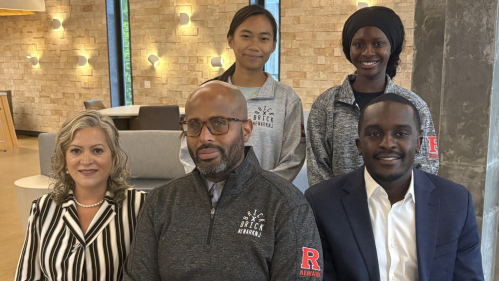
Clayton Walton, an alumnus and executive director of the Rutgers–Newark Office of Global Initiatives and Experiential Learning, is excited about the dramatic influence his program has on students who study abroad in the Global South, which includes Latin America, Africa, and much of Asia. Many go on to dedicate themselves to global social work and sustainability.
Rutgers–Newark students are traveling to remote areas of Ecuador to educate people about clean energy, installing solar energy panels at schools and health centers in Belize, and working with nonprofits in Nepal and India.
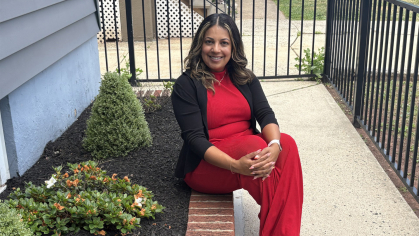
The many inspiring global ambassador stories initiated through the Rutgers–Newark Office of Global Initiatives and Experiential Learning program include those of Virginia De Pascual SASN’26.
“Visiting India was one of the most meaningful and amazing experiences of my life,” De Pascual says. “It deeply impacted the way I see the world and helped me better understand the challenges faced by vulnerable communities.
“When you immerse yourself in their culture, you can understand more about the people,” she says, adding that the experience of working with nonprofits in India inspired her to change her career goals.
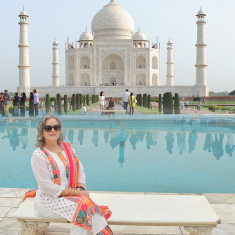
Her trip to India also strengthened her decision to pursue a master’s in social work with a certificate in interpersonal violence and trauma, says De Pascual, who works as an administrative assistant at Rutgers University Brain Imaging Center in Newark.
“I want to focus more on this population and all the social issues that we see like poverty and injustice,” she says.
Clayton Walton, the program’s executive director, said De Pascual’s experience is a good example of his focus on creating local and international partnerships in the Global South that are built around sustainable development and address issues of violence against women and children, as well as agricultural work.
“From these partnerships, we’ve been able to do some projects that students have really gravitated toward,” he says.
Connecting Students with Global Opportunities
One such project is the solar suitcase program, in which students install 50-plus solar suitcases in health centers and schools around the world and teach others about clean energy. “For rural communities that aren’t on the grid, it’s an essential tool,” says Walton, a former dean of student life at Rutgers–Newark, who has directed the Office of Global Initiatives and Experiential Learning for 10 years.
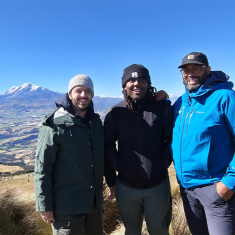
Walton says he is constantly working to innovate, integrate, and institutionalize his students' work. “It’s a collaborative process at Rutgers–Newark, and that’s been really thrilling for me,” he says.
The program helps undergraduate and graduate students and faculty connect with “opportunities to really expand their work and their reach,” he says.
The goal of the program is to create global scholars, Walton says. “We are reducing those barriers to entry and getting students to see that engagement as part of their college experience.”
The program has been focusing on countries in the Global South that are more underdeveloped and need assistance. “In a lot of ways, there is this cultural immersion piece because that is where our students are from,” he says. “Their grandparents are from Central and South America and parts of the Caribbean.”
Walton organizes many of the programs, but others are initiated by students. Sometimes a student will complete a short program over winter break in a foreign country and then come up with an idea for an internship that he can help facilitate, Walton says. Upcoming trips include Nepal, Africa, Belize, and Ecuador. Many of the programs are funded through a mix of scholarship programs, donor funding, and the chancellor’s office.
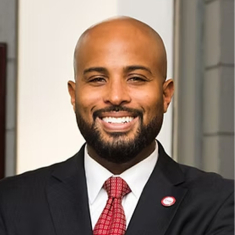
Walton, a graduate of St. Benedict’s Preparatory School in Newark, earned a master’s in education from the University of Maryland–College Park in 2003. He came to Rutgers–Newark in 2005 as assistant dean for the Office of Student Life and Leadership. He earned a master’s from the Rutgers School of Social Work in 2024, where he is pursuing his doctoral studies examining the influence of “high study-away initiatives on career and research readiness."
Global Programs
Carina Bontia, graduate coordinator of the program who holds bachelor’s and master’s degrees from the Rutgers–Newark School of Public Affairs and Administration, traveled with students, including Jason Towindo RBS’29, to Tanzania and Zanzibar in 2023, where they connected with the Maasai community to learn about their history, culture, and livelihood. Students also visited the African Court of Human and People’s Rights and learned about the types of cases that go through these courts, Bontia says.
Towindo, whose family is from Zimbabwe, says he learned the history of Tanzania from the precolonial era through its liberation to its union with Zanzibar.
“Tanzania’s history is really intertwined with my country’s history as they got their independence in a similar era,” he says. “The issues that face Tanzania are the same issues that face my country now.”
He hopes to return to Zimbabwe and be a part of the economic development there.
“I think there are not enough Africans at the table when it comes to discussing Africa and developing Africa,” Towindo says. “My ultimate goal is to start an investment fund that specifically invests strategically in sub-Saharan Africa.”
Olivia Tutu SASN ’25, MSW ’26, participated in a summer program in Belize in 2024 and in spring 2025, where students visited social service agencies and learned about Mayan and Garifuna culture.
“They talked about the economy growing and tourism expanding in their country,” Tutu says. “It was conflicting because their children would leave the villages, work in the hotels, and then bring back what they’re learning from the tourists. It is very hard to preserve their culture.”
Her experience opened her eyes to global social work.
“It changed my whole perspective of wanting to be a school social worker and working with school-aged students,” she says, adding she can make more of a difference. “I can do global social work, and I can do more than community organizing, and I can do it in other countries.”
Help students engage in transformative research experiences around the world
Please consider a gift to the Office of Global Initiatives and Experiential Learning (OGIEL) Support Fund.