A Remembrance of Rutgers Alumni Lost on 9/11

The memories of the 37 Rutgers University alumni who died on that fateful day were honored on its 25th anniversary with the placing of a wreath and flags beside the 9/11 memorial and the ringing of the Old Queens bell on the College Avenue campus in New Brunswick.
On September 11, 2001, 33 Rutgers University alumni perished in the attacks on the World Trade Center in lower Manhattan, including one alumnus who was a passenger on the plane that hit the south tower. Four more who were passengers on the hijacked plane that crashed in rural Pennsylvania died later that morning.
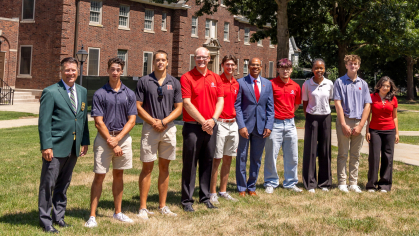
On Friday, all 37 were honored with a wreath and flags placed beside the university’s 9/11 memorial on the Rutgers–New Brunswick campus. At a small ceremony, the names of graduates were read aloud and the historic bell in the Old Queens tower tolled once for each name on the list.

Debjeet Sarkar, an alumnus of Rutgers College Class of 2000 who organized the remembrance, is an emergency room doctor in Maryland who served as a U.S. Army battalion surgeon and completed tours of duty in Iraq and Afghanistan.
“At military funerals, we would always say that we try to remember not just how the person died, but how they lived,” Sarkar said Friday after the flags were placed. “That’s more poignant today than it ever has been, especially for these 37 alums.”
Sarkar said he was inspired six years ago when he first saw the university’s 9/11 memorial—a plaque with the names and years for each Rutgers graduate beneath an oak tree planted in their memory in 2002.
“It was just remarkable that the school did such a wonderful thing,” Sarkar said. “It felt right to try to find ways to remember those 37 alumni.”
Thirty-Seven Alumni
Of the alumni who died on 9/11, 27 graduated from programs in Rutgers–New Brunswick, while 11 graduated from Rutgers–University Newark. (One alumnus, David O. Campbell, earned degrees from both locations: Rutgers College in 1972 and the Graduate School of Management in Newark in 1974.)
Patrick J. Quigley IV, a 1982 Rutgers College art history graduate who went on to become a partner at PriceWaterhouseCoopers (now known as PwC), was on the plane that hit the south tower of the World Trade Center. An endowed scholarship honoring Quigley continues to support art history majors.
Four alumni were on the hijacked flight that crashed in Shanksville, Pennsylvania, after passengers alerted to the terrorists’ intentions to hit a prominent site in Washington fought back and diverted the plane. Those alumni were Donald Peterson GSM’67, who was joined by his wife, Jean; Colleen L. Fraser LC’74; Patrick J. Driscoll GSNB’75; and Richard Guadagno CC’84.
The remaining 32 alumni who died were in the World Trade Center towers that day, including Neil G. Shastri, a 1998 Rutgers Business School graduate whose friends and family have established endowed scholarships in his memory.
You can view a list of all the alumni with graduation years on the Rutgers 9/11 memorial page. For a list with links to more information and photos, visit the Rutgers University 9/11 memorial page on the Voices of September 11th Living Memorial Project.
In addition to the New Brunswick remembrance, a ceremony was held at Rutgers–Newark on Friday.
Sharing Stories for Younger Generations

Rutgers runs deep in Sarkar’s family. Two of his uncles are Rutgers graduates, as are all three of his siblings. He also has a niece who earned a degree in May and a nephew who will graduate next year. When he was young, his father managed properties in New Brunswick, so visiting Easton Avenue regularly are some of his “earliest memories,” he said.
A year after his Rutgers graduation, Sarkar moved to New York to attend New York Medical College only a few months before the attacks in 2001. He was north of the city in Westchester County when the attacks happened and remembers how difficult it was to make a phone call to check on his friends and family.
Now that 25 years have passed, a majority of Rutgers undergraduates and some recent graduates were not born when the attacks took place.
“I tell the military students that I teach and train to try to imagine that you can’t reach the people you love and care about,” he said. “There was that apprehension and dread and just not knowing. That’s something I always remember.”
Sarkar has worked as an E.R. doctor at Johns Hopkins-Howard County General Hospital since 2013 and teaches as a part-time faculty member at the Uniformed Services University of Health Sciences. He served in the Army from 2001 through 2012, which included combat duty in Iraq and Afghanistan, and achieved the rank of lieutenant colonel. He remains in the Army’s Inactive Ready Reserves (IRR) program.
In 2020, he founded a small nonprofit, Operation Restore Decency. He said its mission has shifted from supporting people during the COVID pandemic to focusing on helping fellow veterans and promoting civic engagement, such as the Rutgers remembrance on Friday.
“I still have a strong pull to serve,” he says.
Support the Rutgers World Trade Center Health Program
Consider a gift to the Rutgers Environmental and Occupational Health Sciences Institute (EOHSI) 9/11 First Responders Support Fund. For more about the program, read “Twenty-Five Years Later, the 9/11 Health Crisis Continues to Impact Responders.” The program provides medical monitoring and treatment for eligible rescue, recovery, and clean-up workers who responded to the 9/11 terrorist attacks.