‘Knowledge Stays with You Forever’
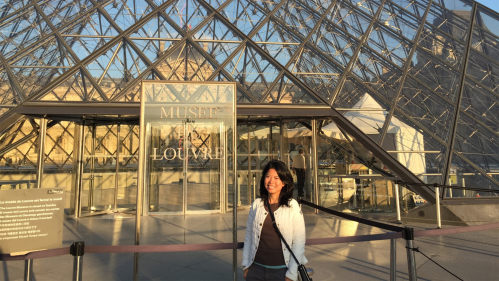
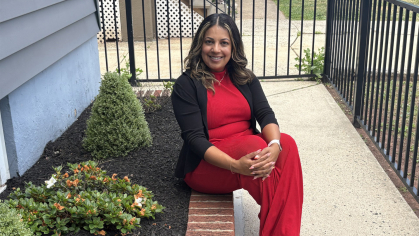
Despite growing up as a child of survivors of the murderous Khmer Rouge regime in Cambodia, Samphoas Huy was raised by a family that valued education. Donor support helped Huy earn her graduate degrees at Rutgers–Newark.
Samphoas Huy grew up in a small hut without running water or electricity in Cambodia in a period following the horrific devastation inflicted on the nation by the Khmer Rouge regime. Estimates indicate that roughly two million, a quarter of the nation’s population, died in the period from 1975-1979.
“I was born after the Khmer Rouge were pushed out by Vietnam and the Cambodian salvation troops,” says Huy, who was born in 1984. “I was a child who was affected directly by the Khmer Rouge regime. Our basic needs were destroyed, including schools and hospitals.”
Her parents’ lives were thrown into chaos. “My parents often sacrificed their own needs,” says Huy GSN ’19, GSN ’24. “They preferred not to eat good food or buy new clothes so they could save as much as possible for their children’s education.”
Since the government did not pay teachers well, her parents paid the teacher a subsidy. “My mom told me to study hard and value education,” she says. “Only education can set you free from poverty and dependency.”
Huy was able to realize her parents’ dream of pursuing her education thanks to a financial aid waiver that enabled her to study at Rutgers–Newark, where she earned her master’s and doctoral degrees in global affairs. She finished her dissertation in 2024. The Documentation Center of Cambodia provided her with work and assisted her with living expenses while at Rutgers. The Margaret McNamara Memorial Fund also helped with her master’s field work to write her thesis.
Her mother always said “knowledge stays with you forever, and no one can steal it from you,” Huy says. “The more you use it, the more progress you will make. It is the only asset that can stay with you for life.”
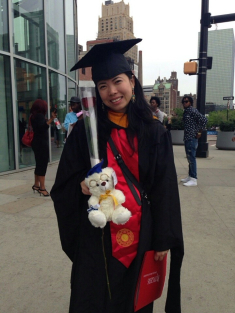
Huy took her mother’s words to heart. After attaining two undergraduate degrees from the Royal University of Fine Arts in Cambodia and working for years to help female victims of the Khmer Rouge seek justice, she was thrilled when she was offered the opportunity to study at Rutgers University.
Huy’s father encouraged her to get her doctorate because he wanted her to be independent. “He wanted his daughters to be strong and able to protect themselves from any kind of abuse, whether physical or emotional.”
“Rutgers opened my eyes,” she says. “At Rutgers, professors ask you to read and research, analyze and create your own thinking.”
War Impact
Huy recalls witnessing violence “that totally traumatized me.” The war had a huge impact, and the atrocities and genocide affected families, the community, and the nation. “Today, the government is still fixing the problems, and it will take years,” she says. “My father and my mother lost their career stability, and our family turned upside down.”
Her mother worked as a nurse, but it was her father’s job as a police officer that they had to cover up, or the family would have been executed by the new regime. The family lived in Phnom Penh before the Khmer Rouge took over the country in 1975, and her parents were forced into labor camps in Battambang province.
The Khmer Rouge forced her parents to work long hours in the rice fields with very little food and water when her mother was five months pregnant. They also arrested and killed her cousin, whom they accused of being a spy because he owned a radio.
The Khmer Rouge killed educated and intellectual people, including physicians, in the late 1970s. As a result, the health care system in Cambodia was lacking, and many people had to travel to receive adequate care.
Almost 40 years later, her aunt and brother died from cancer in 2018. During the pandemic, several of her family members were hospitalized due to COVID. Huy helped pay for her father to receive cancer treatments in Singapore. He later traveled to France for treatment for cancer and heart disease, but he died during surgery.
International Tribunal
Huy says she empathized with many victims of the Khmer Rouge regime who shared their emotional testimony when she worked on the International Tribunal in Cambodia from 2008 to 2009. Many women were abused, she says. “They did not receive justice, and I would become so emotionally overwhelmed that I would cry out. There was just so much sadness.”
Huy worked with the Extraordinary Chambers in the Courts of Cambodia (ECCC), an internationalized tribunal with a mandate to prosecute the senior leaders of the Khmer Rouge and those most responsible for Khmer Rouge atrocities. While at the Tribunal and Documentation Center of Cambodia, she worked with victims who participated in the international trial proceedings.
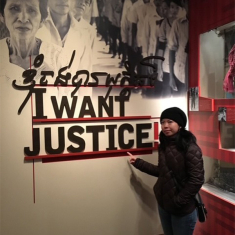
When she was in the United States, she helped create a six-month temporary exhibition titled I Want Justice at the U.S. Holocaust Museum in Washington D.C., which focused on victims of the Khmer Rouge.
Moving to America was challenging for Huy, at first. “For the first semester, I found it very difficult because everyone is speaking so fast, but I adapted,” she says.
This was different than how she learned to study in Cambodia, which was more memorization and repetition. “I had to learn to build my analytical skills and my critical thinking skills.”
Huy interned with Voice of America, where she did translation work and interviewed a professor from Cambodia. She also worked at Rutgers, conducting research on the Khmer Rouge regime for two books.
Huy enjoyed working with mentor and advisor Alex Hinton, whom she found “outstanding and inspiring.” “Rutgers professors are very understanding of international students and are very open minded,” she says.
Hinton, an anthropology professor and director, Center for the Study of Genocide and Human Rights at Rutgers University, commended Huy. “Samphoas’ path to Rutgers is remarkable in so many ways,” Hinton says. “She comes from a country where a genocidal regime targeted intellectuals and then, amid the Cold War, Cambodia faced sanctions and the challenges of rebuilding society, including an education system that had been largely scrapped by the Khmer Rouge regime.”
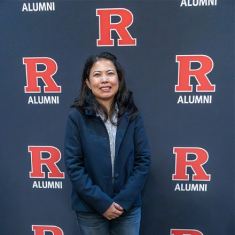
Huy is part of a group of pioneering young Cambodians who have helped rebuild Cambodia by studying abroad and obtaining advanced degrees, Hinton says. “Most are men due to restrictive gender norms. This is part of the reason Samphoas has dedicated herself to helping others with a special focus on women who were victimized by the Khmer Rouge.”
She met her husband, Kim Seng NGOV, in New York and moved with him to Argenteuil, a suburb north of Paris, France, where they have lived for the past nine years. Her husband owns a banking and insurance consulting firm in France. They have two children.
Huy, who works as an academic assistant at ISIPCA, a post-graduate and vocational school in Versailles, France, specializing in perfume, cosmetics, and food flavor formulation, says she remembers her mother’s words about the importance of education and kept them in mind while studying at Rutgers. “Even if I gave you a mountain made of gold, if you are not educated, you would not know how to manage it well.”
Be Part of the Rutgers Story
Discover giving opportunities that support Rutgers.