New York City Health Commissioner Credits His Success to Rutgers
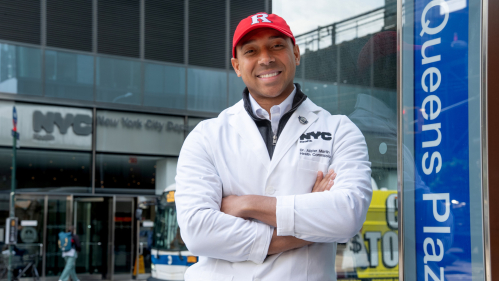
Alister Martin found his path to medicine through the Office for Development and Academic Success, which supports students in their quest to excel in science and math.
The commissioner of the nation’s oldest and largest public health department believes he might not be working to protect the well-being of more than 8 million New Yorkers if it weren’t for the time he spent as a student at Rutgers.
Alister Martin, a physician and 2010 Rutgers graduate, was recently tapped by Mayor Zohran Mamdani to lead the New York City Department of Health and Mental Hygiene, overseeing the agency’s $2.5 billion budget and more than 7,000 employees. He is working to launch a public health agenda focused on affordability, addressing the root causes of illness and making sure services reach the people who need them.
Martin took on the latest in a string of high-profile positions—which have included working in the White House and teaching at Harvard—more than two decades after he was expelled from high school, when he got into a fight with members of a street gang in his Neptune neighborhood. At that moment, he thought he might never go to college.
“It is not an understatement to say that Rutgers saved my life,” Martin said.
Between high school and college, Martin played competitive tennis and was recruited to Rutgers in 2006 by an assistant coach, Bob Stanicki, who encouraged him to take the GED and get his education back on track.
He found his path to medicine after meeting Kamal Khan, the director of the Office for Development and Academic Success (ODASIS), a program that supports students in their quest to excel in sciences and mathematics, which lead to professional health care careers and graduate programs.
Martin wanted to be a doctor like the ones who treated and saved his mother, a biology teacher who raised him on her own and survived metastatic breast cancer.
“For the first time in my life, I had seen real heroes, people who brought my mom back,” he said.
Rutgers showed him how to fulfill that dream. He heard Khan speak about students in ODASIS who were together, studying and pushing each other. He realized his love of competition as an athlete could translate to his academics.
"Dr. Alister Martin was a very unique person who, instead of just sitting down with a book and reading, truly visualized and internalized everything he studied,’’ Khan said. “He used to study with a friend, he said, not leaving their study room until they had completely drawn, mapped out, and quizzed each other on all the material several times. He had a vision and it is coming to fruition."
Martin got involved with the program, which is now celebrating its 40th anniversary, and graduated summa cum laude from the School of Arts and Sciences at Rutgers–New Brunswick.
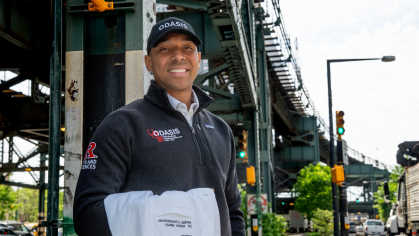
After graduation, Martin attended Harvard Medical School. He went on to serve as a fellow in the White House Office of Public Engagement and as an advisor to Vice President Kamala Harris. He also worked as an Emergency Department physician at Massachusetts General Hospital and an assistant professor at Harvard.
“None of this would have happened if I didn’t have the foundation I got from Rutgers and ODASIS,” Martin said.
As the city’s top health doctor, Martin is set to help Mamdani with his public health agenda to improve the lives of New Yorkers. One program that Martin extended during his first week in office sends nurses into the homes of mothers struggling to make ends meet to provide critical health care services.
“We're going to demonstrate to the country what it looks like when a health department meaningfully addresses affordability and for the first time really focuses the conversation on public health around addressing the financial instability that is making people sick,” said Martin. “We know this from the data, so we don't have to study this anymore.”
He is also working to build back trust in public health which, he said, has fallen precipitously since the COVID-19 pandemic. He wants New Yorkers to understand what public health offers and how their daily lives can be improved with fewer emergency room visits, healthier pregnancies and reduced financial stress due to medical costs.
“It’s drawing the connection between the problem that they have and the solutions we can bring,” Martin said. “The mayor calls this pothole politics.”
Data will play a central role in carrying and measuring the city’s public health message. But so will telling stories that up until now have often been invisible, Martin said. Crucial to gaining support will be the ability to highlight the impact of public health services and align them to reimbursement mechanisms, he said.
“The way I think about it is much more focused on how we can address the lived realities that people are struggling with,” he said. “If we do that, we'll rebuild the trust. People will see that we’re taking care of them.”
Martin said he understands that the challenges he faces are significant and include a wide range of issues from adequate funding and accessibility to chronic disease and housing instability. But, he said, he and the mayor believe showing up and meeting people where they are, prioritizing prevention, equity and visibility along with a proactive approach to community-centered care, will result in meaningful change.
“We’re not talking about creating something entirely new,” he said. “What we need is intervention, meaningful programs and a funding infrastructure that works. We are going to do everything we can to make this happen.”
Support Students
Consider a gift to the Rutgers Office for Development and Academic Success (ODASIS), which provides support for students and helps them remove financial barriers in their path to careers in medicine or other health-related fields.
Give Now