From World War II Ruins to a Rutgers PhD
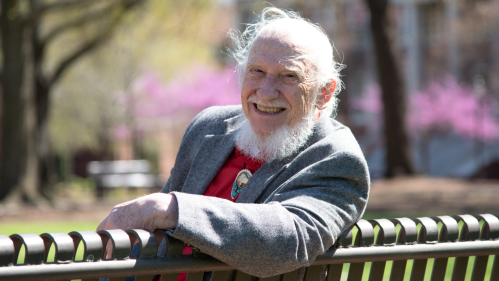
Gerhard Kalmus, who immigrated to America as a teen and served in the U.S. Navy, earned his master’s and doctoral degrees in biology from Rutgers and went on to a career as a professor and administrator in North Carolina. In gratitude for guidance he received as a graduate student, he is giving back by providing for a scholarship in his estate plans for Rutgers students in New Brunswick and Camden.
Born in war-torn Berlin near the end of 1942, Gerhard Kalmus did not enjoy the comfortable surroundings of a carefree childhood.
“After the bombings, my playground and toys were ruins and bricks,” he says. “The only adults were predominantly women. It was an adventure and I did not know any different, since that was my reality.”
His father, despite having medical exemption from the military, was overheard criticizing Nazi Germany’s leader Adolf Hitler. He was shipped to the Russian front and ultimately to a Siberian prisoner-of-war camp, where he was held for three years. He returned after the war’s end, Kalmus says, looking like “a skeleton.”
In 1952, the family immigrated to Brazil, and then in 1956, Kalmus faced a new adventure when his family immigrated to New York, where he initially was “classified as mentally challenged” in a Manhattan school because he could not speak English. This situation motivated him to learn quickly, adapt, and integrate into his newly adopted country.
As a high school student, he received no guidance about what to do after graduation. Not knowing how to navigate the college admissions process, he joined the U.S. Navy and became a medical corpsman, learning about chemistry and biology. From there, with help from the G.I. Bill, he made his way through academia, earning a Rutgers doctorate in developmental biology in 1977.
Ultimately, the question comes up, ‘Why give anything to Rutgers?’ Rutgers helped me in my career development. My whole life was academia and I’m putting my money into departments that gave me an opportunity and areas I feel are important to students. My thought is, ‘If you can, why not give back?’
That degree set him on a 30-year path as a teacher and adviser at East Carolina University before he retired in 2007. Teaching came naturally, he says, and though he couldn’t necessarily measure his effectiveness, he knew he was on the right track.
“It seems like I was always in teaching mode, and I did enjoy it,” says Kalmus, who won East Carolina’s Teacher of the Year award in 1989. “If you can impart some knowledge to a student and see results—it’s a nice feeling to know that you had a chance to educate another human being successfully.”
Now, to help the next generation of biology researchers and scholars, and in gratitude to Rutgers for helping him find his professional footing, he has included an endowed scholarship in his name in his estate plans, benefiting biology majors with a preference for those studying cell or developmental biology.
“Ultimately, the question comes up, ‘Why give anything to Rutgers?’” he says. “Rutgers helped me in my career development. My whole life was academia and I’m putting my money into departments that gave me an opportunity and areas I feel are important to students. My thought is, ‘If you can, why not give back?’”
Learning about Academia
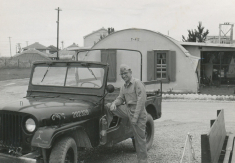
After graduating from high school in 1960 and knowing he’d most likely be drafted anyway, Kalmus opted to join the Navy and applied to become a U.S. citizen.
“My rationale was that if I should come home in a body bag, I wanted to be a U.S. citizen and not a German citizen, but no such luck—bureaucratic wheels turn slowly,” says Kalmus, who also served as a medical corpsman with the Marines. “So I was sent to an American conflict as a German citizen, thus my nickname with the Marines was ‘Germany.’”
He ultimately became a U.S. citizen before being honorably discharged in 1966. Thanks to the GI Bill, he was able to attend the University of California, Berkeley.
“I didn’t know what I wanted to major in, I just knew I didn't want to go back to Vietnam,” he says. “I figured I could speak German, so I majored in German. The next thing I know, we’re studying middle high German and ancient German. I just thought I had to speak—what the heck!”
Kalmus successfully earned his bachelor’s degree, then after reconnecting with an old flame, Karin, in Philadelphia, he got married and moved back east.
“Of course, then, the question mark was, ‘What are you going to do now?’” he says. “I'm married now, so I’ve got to do something.”
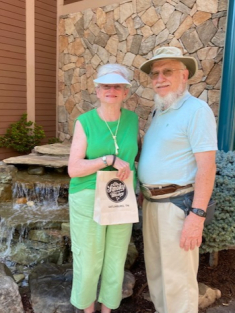
With his background in liberal arts, penchant for teaching, and interest in science (at Berkeley, he enjoyed taking a class in embryology/developmental biology), he was ideal as a substitute teacher at the local high school—so ideal, in fact, that the school offered him a permanent job. The only problem: he lacked teaching credentials.
The solution was a master’s degree. His wife told him about a new master’s program in biology at Rutgers–Camden, where he eagerly set his sights on studying ecology. When he got to campus, however, the faculty member he wanted to study under was retiring and “basically showed me the door.” Flustered, he wandered the halls, trying to course correct. That was when he crossed paths with Professor Hsin-Yi Lee, his future mentor.
“I must have looked like a deer in headlights,” he says. “And guess who showed up? Doggone Lee. I wasn’t the strongest student, but lo and behold, Dr. Lee accepted me. I couldn’t believe it. This was the second year in their master’s program and they needed students. I was at the right place at the right time.”
Lee, who taught cell and tissue biology, suggested that Kalmus take a couple of his classes to see if he liked the subject matter. Then he offered Kalmus a spot in his lab, which initially meant washing lots of glass petri dishes.
“Next thing I know, I find out he is a developmental biologist, and I was interested in embryology,” he says. “I ended up doing research in his lab for two years for my master’s in biology.”
With support from his wife and a gentle nudge from Lee, he then pursued his doctorate—this time, through the Department of Zoology in New Brunswick. Kalmus would still have Lee as his adviser and continue doing research under him, in addition to being his teaching assistant. Beyond his lab work, Kalmus also learned valuable lessons from Lee about navigating higher education politics.
“When I started with him, he was an assistant professor looking for tenure,” he says. “When I got done with my PhD, he was a full professor at Rutgers. He taught me a lot about how to survive in academia.”
‘Instinctively Drawn to Teaching’
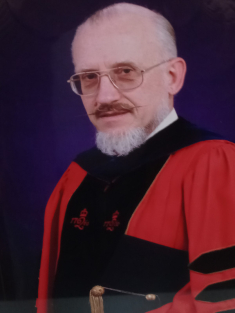
His success is evident in his track record at East Carolina University: Kalmus spent 30 years there as director of undergraduate studies, and 17 years as director of graduate studies, establishing a PhD program. He estimates having had about 125 students for whom he either directed their research or served as a committee member for their thesis or dissertation.
“My problem at the beginning of my education was, where was the guidance?” he says. “I didn’t have it because my parents were working day and night. I was a latchkey kid.”
But Kalmus says knowing what it was like not to have direction ultimately made him more effective as a teacher and mentor.
“I’m not saying everyone has to go through what I went through,” he says, “but I certainly know that what I went through helped me tremendously, ultimately being a pretty damn good mentor. I was instinctively drawn to teaching.”
Kalmus credits Rutgers for helping him find his way academically and professionally, and so endowing a scholarship is something he intuitively feels is the right thing to do.
“Rutgers helped me in my development when I didn't know what I was going to do,” he says. “I don’t know what I would have done if that hadn’t happened. Rutgers treated me well and provided me with the opportunity to become a professor at a university. If creating this scholarship will help future students, then I’ve accomplished my final goal.”
Plan Your Legacy
Consider a gift to Rutgers through estate and gift planning.