An Inspired Professor Gives Back
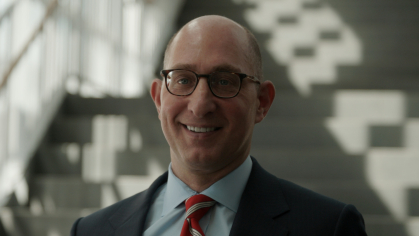
Bob Fishman, a New Jersey native and celebrated scholar who taught at Rutgers–Camden for more than a quarter of a century after finishing his doctorate at Harvard University, has made a series of generous gifts to support students where he was once inspired as a young professor.
When Robert Fishman retired from teaching history in 2022, he returned to New Jersey, where he grew up, and decided to help students in a meaningful way.
Fishman lived a storied academic life at some of the world’s most prestigious universities, earning his undergraduate degree from Stanford before getting a PhD from Harvard. He spent two decades as a professor of architecture and urban and regional planning in Ann Arbor at the University of Michigan’s A. Alfred Taubman College of Architecture and Urban Planning. He also authored two seminal books on the history of cities and urbanism: Bourgeois Utopias: The Rise and Fall of Suburbia and Urban Utopias in the Twentieth Century: Ebenezer Howard, Frank Lloyd Wright, and Le Corbusier. His many honors include the 2009 Laurence Gerckens Prize for lifetime achievement from the Society for City and Regional Planning History.
But before Michigan, Fishman spent 1974 to 2000 on the faculty at Rutgers–Camden: first as an assistant professor of history, then professor of history in 1988. He also served as interim dean of University College–Camden, which focuses on adult students returning to college later in life. Looking back over a life in academia, Fishman says memories of teaching night classes in Camden are among his fondest.
“The evening student, the nontraditional student, became my specialty, out of choice—I grew to really admire them,” he says. “They had very heavy work responsibilities, often in tedious, difficult jobs, along with family responsibilities, and yet they were ready to come to class motivated to learn and get their degrees.”
His years at Rutgers–Camden still resonate with him.
“I’ve experienced many academic settings, but I’ve never experienced better students,” he says. “They were older, more mature, and motivated in a way that traditional undergraduates rarely are. That experience really shaped me.”
Fishman says he has saved most of the money he earned in his lifetime and, when deciding what to do with it and how to help students, he thought of those nights teaching in Camden.
“I saw a school that opened up opportunities for students, a place that really could change their lives,” he says. “That’s what I saw in my 26 years of teaching there and that’s who I wanted to help.”
He has made generous gifts to Rutgers–Camden, establishing the Robert L. Fishman Urban Research and Education Endowment and the Ruth Eisenberg Fishman Endowed Scholarship. He also was a major donor to the William H. Tucker Memorial Endowed Scholarship, honoring a Rutgers–Camden colleague who “died too young.”
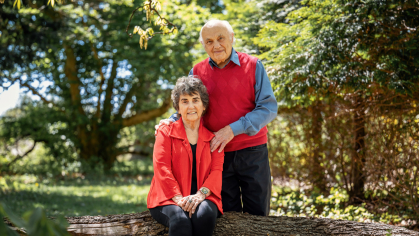
The Ruth Eisenberg Fishman Scholarship is named in honor of his mother, a graduate of the Rutgers New Jersey College for Women (now Douglass Residential College). Fishman says his mother, who graduated in 1942 and died in 2022 at the age of 101, was a nontraditional student herself.
“She basically put herself through college,” Fishman says. “She was a very determined person. I thought it was appropriate to honor her with the scholarship.”
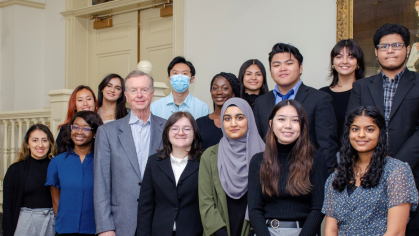
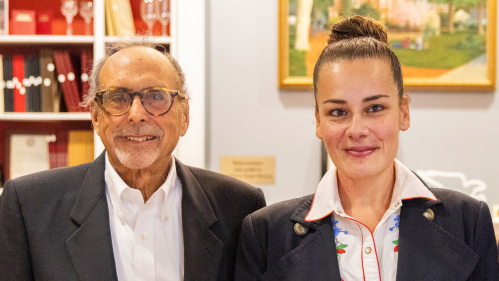
Fishman returned to the Rutgers–Camden campus last year to award the inaugural Ruth Eisenberg Fishman scholarship to Paula Pinto, a working mother. She was exactly the type of student Fishman was looking to help.
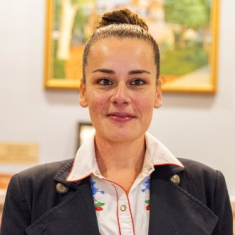
“It is so meaningful to know that others think about nontraditional students like myself,” says Pinto, who lives in Matawan, New Jersey. “I am over 40, a mother, and my daughter is disabled. College once seemed like a distant dream, and now I have the opportunity to build a better future for myself and my family.”
Pinto, who completed her degree in political science in the fall 2025 semester, says the scholarship meant “more than words can express. One day, I hope to help other mothers in situations like mine achieve their dreams too.”
Margaret Marsh, a University Professor who earned her undergraduate degree from Rutgers–Camden, says Fishman’s support is a continuation of his legacy at the university. “He was one of the most prominent and influential urban historians in the United States, and one of the most incisive scholars I’ve been privileged to know,” says Marsh, who served as dean of Arts and Sciences in Camden and also served as interim chancellor twice. “In addition to being an exceptional scholar, he was a brilliant and devoted teacher. He cared deeply about providing a first-rate education to our nontraditional students.”
Marsh says that in addition to being a generous donor, Fishman is involved with the campus community, serving on the Arts and Sciences Dean’s Council.
A Jersey Native
Fishman grew up in Elizabeth, New Jersey, and spent summers in Long Branch along the Jersey Shore. His interest in architecture and urban planning grew out of his love of history.
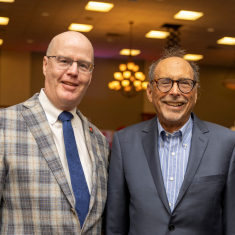
“I’ve always been fascinated by cities,” he says. “Growing up in Elizabeth, there was always a train or bus going into New York City—the great city,” he said. “People often ask me, ‘What is the most beautiful city?’ For me, it’s always Paris, and I’m lucky that I’ve got to spend a lot of time there. But when I think of the greatest city, it’s New York.”
Fishman says he has had a unique career in that he didn’t earn degrees in urban planning or architecture but, based on his published work and interests, rose to become the interim dean at the Taubman College of Architecture and Urban Planning at Michigan.
“I was the only one in the whole college of architecture and planning who had no professional degree in either architecture or planning,” he says. “It was entirely based on my writing as a historian and a kind of critic of cities that got me the job.”
When Fishman taught at Rutgers–Camden, he lived in Philadelphia and came to love the city and its breadth of museums and culture. “Philadelphia, for the money, offers the highest quality of urbanism dollar for dollar,” he says.
At Rutgers, Fishman taught Western civilization classes, along with classes about World War I and II and recalls them all fondly.
“It was a wonderful, multidisciplinary range of classes,” he said. “It was a wonderful time, full of memories.”
Fishman called Rutgers-Camden “one of the greatest, small liberal arts college in America” and helping any nontraditional student make it through is a small reward.
“It’s a real gift to South Jersey and a great source of opportunity,” he said. “Rutgers–Camden really delivers to many thousands of students. That's worth celebrating and supporting.”
Support Excellence
There are numerous giving opportunities to support Rutgers University–Camden.