The Lasting Legacy of a Distinguished Rutgers Partnership
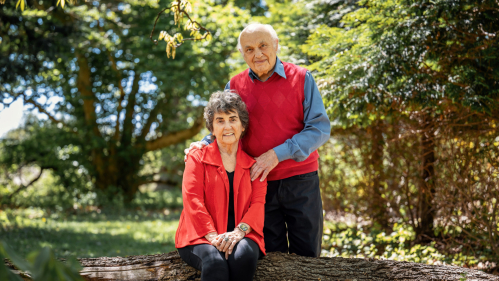
Joanna Burger, a groundbreaking behavioral ecologist who joined Rutgers faculty in 1973, and Michael Gochfeld, a renowned researcher and scholar in occupational and environmental health who joined the faculty of the Rutgers Robert Wood Johnson Medical School in 1980, have a combined experience at Rutgers that spans more than 100 years. Both have made generous gifts to the university that have endowed professorships in their fields.
Joanna Burger and Michael Gochfeld came to an agreement long ago that has served them well in their 45 years of marriage.
“I cook,” says Burger, who pauses and nods at Gochfeld who is sitting across a conference table from her at the Rutgers School of Environmental and Biological Sciences (SEBS). “He does the dishes.”
Gochfeld smiles. “The secret to dishwashing is this: You have a whole bunch of dirty dishes here,” he says gesturing to an imaginary sink on his left. “Fifteen minutes later, you have a whole bunch of clean dishes here,” he says, gesturing to his right. “It’s a finite problem with a clear solution you can rarely find in science.”
Burger and Gochfeld, who married in 1981, have collaborated on much more than dishwashing. Their tireless research and publications have sought science solutions from ecology to environmental and occupational health issues in research projects that have taken them across New Jersey, throughout the United States, and around the globe.
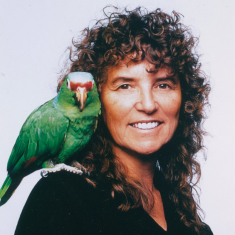
Their explorations continue. The day of their 45th anniversary on August 1, they embarked on a research trip together to Australia where Burger continued her study on understanding the complexities of the behaviors of parrots. She is a leading ornithologist, authoring many books both academic and commercial, including A Visual Guide to Birds, which was published by Reader’s Digest, and The Parrot Who Owns Me: The Story of a Relationship, a memoir published by Random House that was translated into seven languages.
Those books are only two of a voluminous career for Burger and Gochfeld. Together, they have published about 350 academic papers and 15 books. In total, Burger herself has published more than 700 papers and 30 books. Titles they have collaborated on with shared bylines include scholarly books such as Habitat, Population Dynamics, and Metal Levels in Colonial Waterbirds: A Food Chain Approach, and The Common Tern: Its Breeding Biology and Social Behavior. They also collaborated on 25 Nature Spectacles in New Jersey, which was published by Rutgers Press.
Their research has had significant influence in myriad ways. Long-standing studies from the New Jersey Pinelands and coastal areas to Alaska and beyond have influenced protection of humans and animals. Both have been deeply involved in CRESP, the multi-university, multi-disciplinary Consortium for Risk Evaluation with Stakeholder Participation, founded at Rutgers in 1995. Both were founding members of the consortium now spread across 15 universities which serves to advise the U.S. Department of Energy on its mission of cleaning up the radiologic and chemical contamination legacy of decades of nuclear weapons production. The cleanup benefits hundreds of communities across the country, including Alaska.
Over the past year, they have each given to Rutgers to establish professorships that will continue to advance research and scholarship in the fields to which they have devoted their careers.
In June 2025, the Rutgers Board of Governors approved the Joanna Burger Endowed Legacy Professorship for the study of behavioral ecology within the School of Environmental and Biological Sciences. The professorship was filled in April when Brooke Maslo, an associate extension specialist in the Department of Ecology, Evolution and Natural Resources and a former student of Burger, was appointed to the position.
In October 2025, the Board of Governors approved the Michael Gochfeld Endowed Legacy Professorship, which was created to honor, retain, and recruit faculty members, especially those who are part of the occupational and environmental residency program within the Rutgers Environmental and Occupational Health Sciences Institute (EOHSI), or to support those who advance research and training in the field.
Burger and Gochfeld say their generosity to the university is both an appreciation of what Rutgers University has supported them in achieving and also a way of sustaining research in their respective fields.
“Rutgers has been good to us,” Burger says. “We felt like we wanted to give back to an institution that has allowed us to have careers that we loved.”
Childhood Love Affairs with Birds
Burger’s father was a farmer near a small town north of Albany, New York known as Niskayuna, which means cornfields in Iroquois. “My first job at age 7 was walking around the fields to scare the crows and blackbirds away,” Burger says.
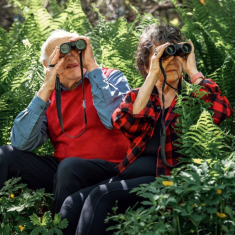
When she turned 8, she was permitted to do the job on horseback. Her father also started pointing out bird nests, which fascinated her, and then she took a keen interest in the gulls that passed through each spring and gathered in flocks to feed behind her father’s plow that exposed earthworms. “I was really, really interested in birds, ” she says. “Where were these bids coming from and where did they go?”
Burger says because she was a farmer’s daughter, schools placed her in a track to take clerical classes and become a secretary. But after the support of one teacher who saw her potential and her persistence, she found a path to the University at Albany, where she earned a bachelor’s degree, followed by graduate school at Cornell, and ultimately a doctoral program at the University of Minnesota. She credits her earlier high school coursework for facility with managing complex data sets and speed typing. She joined the Rutgers faculty in 1973 and continues as full-time faculty, managing three long-term studies, teaching a course in animal behavior, and lecturing in the School of Public Health.
For Gochfeld, who was born in Philadelphia when his family lived in Camden, he was a fourth-grader in Putnam Valley, New York, when his teacher signed the whole class up as junior Audubon Society members. “For 10 cents a month I got a pamphlet and a picture of different species,” he says. “I became really enamored with birds and kept my membership alive after leaving fourth grade.”
He went on to graduate from Oberlin College with a degree in ecology. However, when he told his parents he wanted to go to graduate school to study “of all things, mushrooms,” they were not exactly supportive of his choice, instead persuading him to go to medical school, a choice he always appreciated. After earning an M.D. from Albert Einstein College of Medicine, he served in the U.S. Navy Medical Corps including a year in a small, rural hospital in South Vietnam, at the height of what he says the Vietnamese called “the American War.” From 1966–1968, he treated Vietnamese civilians with a wide variety of conditions, an experience that informed his current lectures on wartime medicine. “We were taking care of people often with minimal supplies, often without antibiotics, often without bandages and basic things like that,” he says.
Upon returning stateside, he resumed training in occupational medicine and earned a Ph.D. in environmental biology at City University of New York, which put him on his path toward occupational and environmental health. In 1980, he joined what is now known as the Rutgers Robert Wood Johnson Medical School (RWJMS) where he was instrumental in building the school’s program in occupational medicine.
Establishing their Partnership
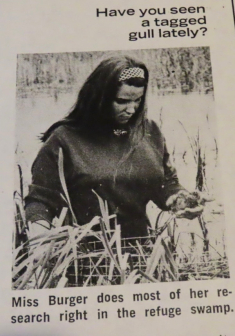
The answer to the question of when Gochfeld and Burger first met is unclear. “We always say we met at different times,” Burger says.
Gochfeld remembers meeting Burger about 1969 at a Christmas bird count event. “She showed me her scrapbook of the work that she was doing with the marsh-nesting gulls in Argentina and Minnesota,” Gochfeld said. “One picture of her wading waist deep in a marsh seemed to indicate something special about her.”
Burger, however, doesn’t remember that meeting. Her recollection is that she met him about a year later in a different place, an American ornithological meeting.
Whenever they met, it led to a decade of friendship and ultimately a successful marriage.
“Unlike many people who have been married 45 years, we really love being together constantly and doing things together all the time,” she says.
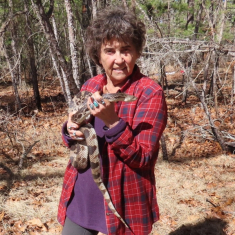
Their togetherness continues with meetings, conferences, and research trips they do in constant collaboration. Two of the studies she has led for about 50 years each that they have worked on include researching population dynamics and contaminants in birds of Barnegat Bay on the Jersey Shore and the ecology, breeding, and survival of pine snakes in the New Jersey Pinelands. She also continues working with current and former students studying the migration of Red Knots and other shorebirds though Delaware Bay.
Although Gochfeld has officially retired, he lectures on a variety of topics in the medical school and School of Public Health, and he assists Burger on her research work, which she plans to continue. “I’m planning on doing this for another 15 years,” Burger says.
When she one day does retire, gifts that Burger and Gochfeld have made to the university to support professorships will continue to sustain work in their fields of behavioral ecology and environmental and occupational health through their endowments.
“When our work is done, we will be happy to know that our legacy will continue here at Rutgers in the fields to which we have devoted our careers,” Burger said. “Protecting and sustaining natural ecosystems is increasingly important in the light of expanding populations and global changes in habitats and climate. And we still have time to contribute to efforts to understand the promises and threats of AI.”
Gochfeld added, “The studies that we have done and the work that will continue to be done here at Rutgers are critically important to sustaining and improving human health in home, community, and workplace environments,” he said. “It is gratifying to know that we can support these efforts that have meant so much to us into the future.”
Support Science
Explore giving opportunities at the School of Environmental and Biological Sciences (SEBS) and the Rutgers Health Environmental and Occupational Health Sciences Institute (EOHSI).