Legacy Professorship Aims to End Parkinson’s Disease
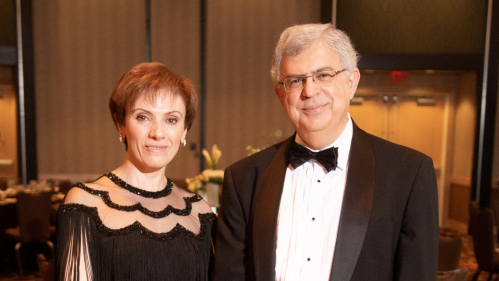
A generous gift from Rutgers Health leaders M. Maral Mouradian and Suhayl Dhib-Jalbut has established an endowed legacy professorship to focus on Parkinson’s disease research with the ultimate goal of finding a cure.
When M. Maral Mouradian won the Distinguished Collaborative Research Award from the World Parkinson Congress earlier this year, she noted in her acceptance speech that her decades of research on the disease that impacts more than 10 million people worldwide is her life’s work.
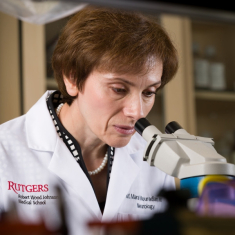
“Parkinson’s disease is my passion more than a profession,” says Mouradian, a Distinguished Professor of Neurology who is founding director of the Robert Wood Johnson Medical School (RWJMS) Institute for Neurological Therapeutics and vice chancellor for faculty development at Rutgers Health. “I derive my inspiration from the patients I care for.”
It’s that passion to ultimately find a cure for Parkinson’s disease, a chronic progressive neurodegenerative disease similar to Alzheimer’s, that motivated Mouradian and her husband, Suhayl Dhib-Jalbut, to make a gift establishing the M. Maral Mouradian and Suhayl Dhib-Jalbut Family Endowed Legacy Professorship. The professorship—which ultimately will be a faculty position at the future Rutgers School of Medicine when the pending accreditation of the new school that unites RWJMS and New Jersey Medical School (NJMS) receives approval—supports tenured or tenure-track scholars in the Department of Neurology, specifically for Parkinson’s disease research.
Mouradian says addressing Parkinson’s is important on many levels.
“The economic impact in the country is upward of $83 billion a year, and it impacts not only the patient, but families and society,” she says, noting that one million people in the United States suffer from Parkinson’s and there are 90,000 new diagnoses each year. “It’s a tough disease.”
Mouradian says the peak age of people diagnosed with Parkinson’s is around 60 and that it usually starts with a little tremor or slow movements or stiffness. Eventually one’s gait and balance are affected, and patients frequently develop a whole host of issues, including dementia, hallucinations, blood pressure and swallowing problems, she says.
“This is an important cause for me,” says Mouradian, whose research contributed to the development of novel treatments and has been honored with numerous awards, including being named a fellow by the American Association for the Advancement of Science and elected to the prestigious Association of American Physicians. “This legacy professorship will continue to support someone to do important work for Parkinson’s research and find better treatments and a cure. It has been my life’s work, and I want it to continue after I’m done with my career.”
A Partnership Begun in Medical School
Mouradian and Dhib-Jalbut met as medical students at the American University of Beirut, where he was two years ahead of her in training.
“The first thing that impressed me was her care for patients and her grasp of their medical conditions and treatment plan as a third-year medical student,” Dhib-Jalbut says.
After they finished medical school, they moved to the U.S. in the early 1980s, where they trained in neurology at the University of Cincinnati Medical Center before joining the National Institutes of Health in Bethesda, Maryland, a few years later.
Prior to joining Rutgers in 2003, Dhib-Jalbut specialized in multiple sclerosis and neuroimmunology research, while Mouradian trained in experimental therapeutics of neurodegenerative disorders at the National Institute of Neurological Disorders and Stroke (NINDS) followed by training in molecular biology under the tutelage of the Nobel Laureate Marshall Nirenberg at the National Heart, Lung, and Blood Institute (NHLBI). In 1990, she established and led the Genetic Pharmacology research program at NINDS and began her focus on Parkinson’s disease.
Dhib-Jalbut, the Ruth Dunietz Kushner and Michael Jay Serwitz Chair in Multiple Sclerosis and director of the Rutgers Robert Wood Johnson University Hospital Center for Multiple Sclerosis, has served as chair of the departments of Neurology at RWJMS and NJMS. He has been recognized for his “visionary leadership, groundbreaking research, exceptional patient care, and a deep commitment to educating the next generation of physicians and scientists.” Both Dhib-Jalbut and Mouradian were named honorary alumni of RWJMS in 2019.
Mouradian, who came to New Jersey to fill the William Dow Lovett Endowed Chair for Parkinson’s Research, which she continues to hold, said creating this second endowed position focused on Parkinson’s—which was endowed in December and approved by the Rutgers Board of Governors in June—will have tremendous long-term benefits in the fight against the disease.
“An endowed position can be a recruitment tool,” she says. “I'm a good example of that. The endowed chair that I hold was a major factor in my decision to join RWJMS.”
Support Parkinson’s Disease Research
Please consider a gift to the Robert Wood Johnson Medical School Department of Neurology in support of Maral Mouradian’s research.