‘A Personal and Meaningful Mission’ for Child of Holocaust Survivors
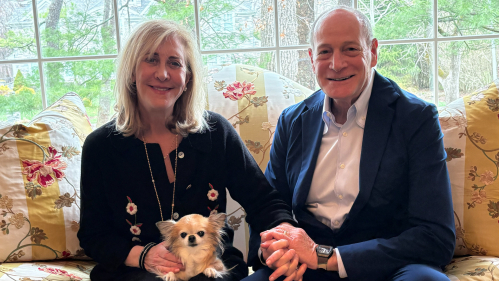
Dental school professor and wife give back to survivors through dental program
After the Nazis occupied Poland, Esther Nieroslaski and Martin Dieroczinski, who were both living with their families in Lodz, Poland, were forced to move to the local Jewish ghetto before the Nazis captured and sent them to concentration camps.
Esther, her mother, and two older sisters were sent to Auschwitz, while Martin was sent to a different camp before joining the agony of Auschwitz. The couple met later at Feldenberg, a liberation displacement camp for refugees, and reconnected at a Holocaust Survivors Group in Newark.
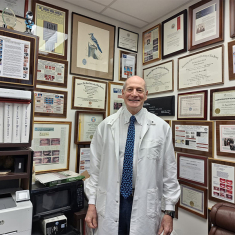
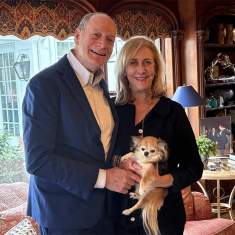
Esther and Martin, whose last name was changed to Drew at Ellis Island, married and eagerly started a family. Howie, their youngest son, proudly treated his parents’ dental needs, many of which were a direct result of surviving the brutality of concentration camps. With this in mind, Howie, an alumnus and Rutgers School of Dental Medicine Vice Chairman of the Department of Periodontics and Director of Implantology, and his wife Ina Drew are generously giving back to a cause which resonates on both professional and deeply personal levels.
Howie, a professor of periodontics, and Ina helped establish the Rutgers School of Dental Medicine Holocaust Survivors Program, which offers complimentary dental care to survivors. The Drews have donated more than $1 million to the dental school to fully cover the costs of the program, which started six years ago.
The Rutgers School of Dental Medicine has chosen to recognize and honor the Drews on Yom HaShoah, or Holocaust Remembrance Day, observed from sundown April 13 to the evening of April 14, honoring the six million Jews killed during the Holocaust. In tribute, the school also celebrates the Drews’ generosity in supporting more than 120 Holocaust survivors to date in the program. Yom HaShoah focuses on remembrance, heroism, and resistance, tied to the Warsaw Ghetto Uprising and differs from the Holocaust Remembrance Day observed by the United Nations on January 27, marking the liberation of Auschwitz.
“One of our school’s core missions is to provide compassionate care in a humanistic environment, and this is exactly what we do through the Holocaust Survivors Program, thanks to the incredible vision and generosity of Ina and Howie Drew,” says Cecile A. Feldman, dean of Rutgers School of Dental Medicine. “Our students get to meet—sometimes for the first time—a Holocaust survivor and hear their stories firsthand. In the process, an incredible connection develops between the patients and the students. Our patients begin to see students and faculty providers as their family. This is such a life-changing program for everyone involved.”
Call for Help
Howie Drew, who opened his practice in Westfield and Verona, New Jersey, says he became aware of the need for dental care for Holocaust survivors in the community when he read about it in his synagogue’s newsletter. The Jewish Federation of Greater Metrowest’s call to available dentists followed a recent survey of Holocaust survivors who said they were most worried about loneliness, isolation, and lack of dental care. Many suffered from poor nutrition and hygiene in the concentration camps, which caused detriment to their teeth. Additionally, the expense of dental care was a burden that many could not take on.
“We sat down, and we talked, and I said, ‘I think the dental school is the perfect environment for the Holocaust survivors,’” Howie says of his talk with federation staff, adding that the dental school offers specialists in every field.
Howie was truly motivated and collaborated with his dental school colleagues to create a team for the program, and he and Ina decided to fund it, he says. It has a special phone line and a Dental Navigator System, an advocate for Holocaust survivors who assists them. The Jewish Federation supplies transportation.
Dental school staff, faculty, DMD candidates, and post-doctoral residents who work with survivors are required to receive Person-Centered Trauma-Informed Care training. “They learned how to treat these individuals, how to empower them and give them the respect that they need,” he says. And the staff can’t believe “the stories the survivors share, and how lovely these people are.”
The training ensures they have the best experience and receive the highest, most thoughtful level of care from our top staff and Doctor of Medicine in Dentistry candidates, Howie says. “Right away, they are assured that there is no cost, no matter the extent of the treatment required.”
Michael Conte, senior associate dean for clinical affairs at the dental school, says it has been an incredible experience. “It’s not every day you meet a Holocaust survivor, and it has been my experience these survivors are truly amazing people with significant unmet dental needs,” Conte says. “Our students have learned so much about providing trauma-informed care to these patients, and the Holocaust survivor patients overwhelmingly reported genuine satisfaction with the VIP care they received.”
To date, 120 patients in the program have had more than 2,200 visits to care for their dental needs. The survivors are usually in their 80s and 90s, and they like being around the younger, energetic DMD candidates and post-doctoral residents who care for them, Howie says. “They treat them like their grandparents.”
Painful Memories
Howie created the program with his parents in mind. His father passed away many years ago, but they lost his beloved mother recently, not far from her 98th birthday, he says.
“My parents rarely spoke about the Holocaust,” he says. “It was too painful for them. As we got older, we wanted to know more, and they would tell us about the atrocities.”
Their stories are part of the Spielberg Shoah Foundation at the Holocaust Museum, which is home to more than 55,000 video testimonies of Holocaust survivors and witnesses preserved in a visual history archive to combat antisemitism and preserve history. “So, the three sisters, my mom being the youngest, were taken by cattle car to the concentration camps,” Howie says.
A Nazi officer saw his mother right away, that she was the youngest, and she was holding onto her mother. “The Nazi separated my mother from my grandmother. They didn’t know it at the time, but my mother was put into the concentration camp, and my grandmother was sent to the gas chambers.”
One of Howie’s aunts spoke three languages and “she asked the Nazi soldier in German ‘where is my mother?’ and he said, ‘That’s her’ and he pointed to the smokestacks.”
His mother, who was 14, survived the camp together with her sisters for six years. “We all believe that the reason they survived is because they took care of each other,” he says. “They helped feed each other. When one was sick, they would help, but they were all fiercely motivated to live.”
The sisters worked in the ammunition factories making bullets. “They were young, healthy kids, so they kept working.”
Ina Drew says she is truly proud of her husband, who read about the need for Holocaust survivors and made it “a real personal project.”
“Howie is being modest,” Ina says. “Howie was the one who saw this email from the temple, grabbed onto it, and started thinking about how he could help and why this is so personal and meaningful to him. He thought about how this could be such a legacy because he grew up in a family of Holocaust survivors, and he has taken it on really as a personal mission.”
A 2025 study says that more than 220,000 Holocaust survivors are living globally, with 16 percent living in the United States. A 2024 report notes that 6 percent of the survivors live in New Jersey. All are elderly, so Ina says she does not know how long the program will be viable, but they plan to keep it open for the special population who are still with us and still in need. “I think it hits a real sweet spot,” she says, but adding if her mother-in-law survived the Holocaust at age 14 and, if alive, would have turned 100 this year.
Howie and Ina met in biology class as eighth graders at Guadineer Middle School in Springfield. The couple started dating in their junior year at Jonathan Dayton Regional High School in Springfield, where Howie played on the basketball team.
Both Howie and Ina studied at Johns Hopkins University. Howie was a pre-med public health major and had a partial basketball scholarship, and Ina studied international relations. She later went to graduate school at Columbia University.
The couple married and eventually settled in Short Hills. Howie attended Rutgers School of Dental Medicine, which was then known as the University of Medicine and Dentistry of New Jersey (UMDNJ), and Ina worked for more than 30 years at J.P. Morgan Chase. Their son Alex, a maxillofacial prosthodontist, also participated in the survivor program. Their daughter Sarah, who wrote for Vanity Fair magazine and later worked in human resources, now raises her three children.

Howie Drew enjoyed his private practice. “I loved my clinical practice, but we felt that if I transitioned to more of a full-time academic role at the dental school, then I would also have more time to be with the children,” he says.
Today, he is in constant contact with everybody in this program, everybody at the Jewish Federation, and every Holocaust survivor, Ina says. “I know this because I hear the calls.”
To Howie, the best part is when a survivor smiles—that makes everything worthwhile. “We are doing implants, crowns, and every sophisticated procedure that we can do,” he says. “One of the best things about this program is that it has brought a lot of awareness of the Holocaust and admiration for its survivors. People who are not Jewish have really learned about it, and they have so much respect for these people. It’s mind-boggling.”
Holocaust survivors interested in treatment can call 973-972-5304 to schedule an appointment or visit the website.
RSDM Dean’s Excellence Fund
Gifts to this fund support the greatest need at the Rutgers School of Dental Medicine.