Rutgers–Newark Kicks Off 80th Anniversary Celebration with Focus on Legacy, Opportunity

Rutgers University–Newark celebrated its 80th anniversary at an event that honored its role as a gateway to opportunity and a bedrock of the city and state’s economic and cultural life.
On April 30, 1946, a law signed by the governor of New Jersey merged Rutgers University with the University of Newark, Rutgers–Newark's predecessor, creating the institution that exists today.
With 88 percent of its student body from New Jersey, Rutgers–Newark has evolved to produce internationally regarded, real-world research, often in collaboration with city residents and grassroots organizations. It helps fuel New Jersey’s economy and nurtures its artistic life.
“From the moment I stepped on this campus, I could see that Rutgers–Newark is an extraordinary place,” said Rutgers University President William F. Tate IV. “Brilliant faculty scholars, dedicated staff, and motivated students producing results for New Jersey in our state’s largest city. It’s an impactful combination of social mobility, scholarship, and outreach that’s life-changing.”
Rutgers–Newark Chancellor Tonya Smith-Jackson said, “Eighty years ago, Rutgers University–Newark was founded on a promise of access with purpose. Today, I am proud of the countless faculty, staff, students, and alumni who have carried that mission forward—proving that when opportunity is paired with excellence, education becomes a powerful engine for transforming lives, communities, and our shared future. Our deep and reciprocal partnership with Newark continues to fuel opportunity and transformation for the university and the community we proudly call home.”
The 80th anniversary celebration, which fell on International Jazz Day, provided a chance to showcase the Institute of Jazz Studies—the university’s center for jazz research and education, which includes the world’s largest public jazz archive. The day was filled with music, including a nighttime show at Clement’s Place, the on-campus venue where the institute produces up to 100 performances a year that are free and open to the public.
The Rutgers–Newark community, including staff, faculty, students, and alumni, turned out in force at the event, which featured commemorative items, a Rutgers-branded ice sculpture, and performances by Jimmy Bosch & The Salsa Masters with special guest Stefon Harris, a Grammy-winning vibraphonist and faculty member.
Also at the ceremony was State Senate Majority Leader Teresa Ruiz who represents Newark. She spoke of her own history as a first-generation college student and lauded Rutgers–Newark’s success in placing higher education within reach. “For me, with a mother who got her GED, a father who only went to fourth grade, I know what academics does. It really creates a pathway to become a game changer. But it has to be inclusive. It has to be affordable. It has to be respectful. And it has to be approachable. I can tell you that all those things sit under the same umbrella, and all those things sit in excellence here,’’ she said.
Throughout the year, Rutgers–Newark will be commemorating its history, which evolved from a small constellation of schools and colleges dating back to the 1900s.
Rutgers University merged with the University of Newark to broaden its geographic footprint a year after being named the State University of New Jersey in 1945. Newark was the state’s largest industrial center, and many students were laborers who aspired to enter white-collar professions, especially business and law. Rutgers recognized the need for higher education among city dwellers, most of whom couldn’t afford to live on a college campus, and the value of an educated workforce and citizenry.
From the start, increasing access to higher education has been a key part of Rutgers–Newark’s identity, a legacy that continues. For two consecutive years, U.S. News & World Report has ranked Rutgers–Newark No. 5 nationwide for social mobility, which measures students’ success in moving up the economic and professional ladder. It is also ranked No. 36 among public universities.
“Rutgers University–Newark is unique because we deliver academic excellence and true return on investment at the same time,’’ said Smith-Jackson. “Our U.S. News & World Report ranking of No. 36 reflects strong graduation outcomes, faculty resources, and research impact, while our No. 5 national ranking in social mobility shows that an RU-N degree transforms lives.’’
She added, “As a Hispanic-Serving Institution, a Minority-Serving Institution, an Urban-Serving Institution, and an Asian American and Native American Pacific Islander-Serving Institution, we prove that when access drives excellence, everyone rises."
Rutgers University Board of Governors Chair Amy L. Towers spoke of Rutgers–Newark’s history of making a difference in the lives of students. “Our ambitious students reflect the very, very best of Newark and are changing the trajectory of not only their own lives, but their families and the communities they're a part of."
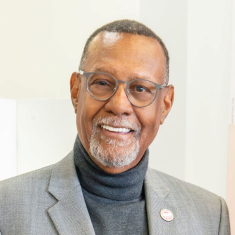
Also speaking at the anniversary celebration was alumnus Richard Roper NCAS'68, who went on to hold a leadership position in the U.S. Department of Commerce under President Jimmy Carter.
In 1968, Roper founded the Black Organization of Students, which in 1969 took over Conklin Hall, successfully demanding a more diverse student body and faculty. Today, Rutgers–Newark is one of the most diverse schools in the nation. He recounted the evolution of Rutgers–Newark since then, particularly its changing relationship with the city.
“We witnessed the beginning of the university's move toward becoming an anchor institution in its home community," Roper said. "University leadership began to embrace the greater Newark environment as a perfect laboratory to explore and examine issues formerly considered off-limits for academic study."
Two student leaders shared their own experiences at Rutgers–Newark.
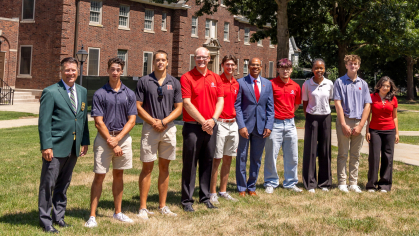
“The student voice has always been one of the most powerful and consistent drivers of Rutgers–Newark’s success,’’ said Adrian Henry, president of the Student Government Association. “It is our ideas, our advocacy, and our willingness to challenge and to lead that push this institution forward. From the classroom to the community, students are not just participants in the story. We are the co-authors.’’
Tiffany Olivera, president of the Graduate Student Government Association, described the role of her fellow grad students and expressed optimism for the next chapter of Rutgers–Newark history.
“As graduate students, we occupy a unique space in that legacy," she said. "We are researchers, educators, professionals. Every day, we contribute not only to our own fields, but to the broader mission of this university and the communities we serve. In many ways, we help shape what the next 80 years will look like. And if today is any indication, the future is in very good hands.”
Support Students
Anyone who wishes to support Rutgers–Newark students along their journey can contribute to the Rutgers–Newark Student Emergency Fund.