Rutgers Alumni are Amazon Leaders
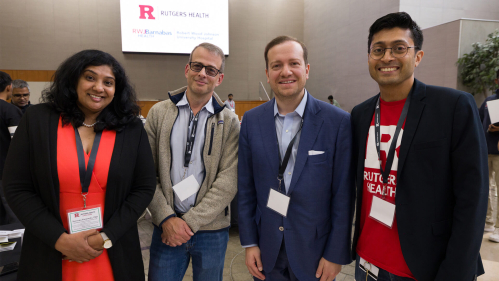
Amazon leaders Jared Saul and Leo Zhadanovsky credit Rutgers for their successful careers and returned to campus to inspire others with their innovative ideas. They are among more than 2,000 Rutgers alumni who work for the retail and technology giant.
Two Rutgers alumni forged their own paths after graduation, coming together years later as successful high-ranking leaders at Amazon, the world's largest e-commerce platform and a leading cloud computing provider.
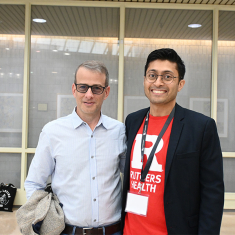
Amazon Web Services Chief Medical Officer Dr. Jared Saul earned his M.D. from Robert Wood Johnson Medical School in 1996, subsequently specializing in radiology, while Amazon Web Services Chief Technologist for Education, State & Local Government, and Elections Leo Zhadanovsky received his bachelor’s from the Rutgers School of Communication and Information in 2007. Amazon Web Services is a subsidiary of Amazon that provides on-demand cloud computing platforms and application programming interfaces to individuals, companies, and governments, on a metered, pay-as-you-go basis. Clients often use these platforms and interfaces in combination with autoscaling.
I would say my Rutgers experience is the reason that I've had the career that I have.
Leo Zhadanovsky
Long before Saul and Zhadanovsky became leaders in healthcare technology at Amazon, they were Rutgers students. Both credit their experience at Rutgers for preparing them for successful careers and were excited to return for the Rutgers Health Hack, an annual event that brings together professionals in medicine and technology. At the event, Saul gave the keynote address and Zhadanovsky provided guidance on artificial intelligence to participants. Organizers say the Rutgers Health Hack illustrates the unique, forward-thinking nature at Robert Wood Johnson University Hospital and Rutgers Robert Wood Johnson Medical School and helps tackle real challenges in health care.
Room to Grow at RWJMS
Saul, who grew up in Upper Saddle River in Bergen County, says he enjoys his current job at Amazon where he brings health care and technology together. “Looking forward, technology is a big part of health care, which is going to change very drastically over the coming years to deliver services that the population needs,” he says. “It’s already happening. It needs to happen, and technology is really a big part of that.”
In fact, Saul says he looks at challenges in health care and “we contemplate the ways in which the technology that we have now at our disposal can make some of what was hard in the past easier or much better.”
Reflecting on his time at RWJMS, Saul enjoyed it, he says. “There was a good camaraderie amongst the other students,” he says. “And I felt like we were all kind of young and ambitious and loved learning. There was an enthusiasm and a forward momentum that was pretty special.”
The medical school also did “a good job of exposing us to a lot of different parts of health care,” says Saul, who graduated from Ridgewood High School. “Certainly, transitioning from the classroom to the clinic and getting to roam around the floors of Robert Wood (Johnson University Hospital) and the old Princeton Hospital and St. Pete's was pretty formative.”
During medical school, Saul says he spent some time with Judy Amarosa, clinical professor of radiology and vice chair for Medical Education and Faculty Development at RWJMS. “She was a dynamo, and she really inspired me,” he says. “She made the suggestion that I should give some serious consideration to radiology.”
Saul, who lives in Pittstown, New Jersey, says he thinks he was drawn to radiology because “it takes the most advanced equipment and capabilities using them to do diagnostics and interventions.”
He would evaluate ultrasounds, CT scans, MRIs, nuclear medicine, regular X-rays, and fluoroscopies, as well as the interventional side of radiology, he says.
“I think my interest in medicine came from a scientific curiosity,” says Saul, who received his undergraduate degree at Tufts University in Boston. “I liked engineering, science, and biology, and I was amazed at how all these things work together.”
After the internet emerged in 1993, Saul initiated an idea for a website to match homeless pets with families, and Petfinder.com was born. His passion project evolved into a business, which Saul sold in 2006 for $35 million to Discovery Communications, the parent company of Animal Planet. This sale expanded the reach and technology, including mobile apps, to connect more than 13,000 shelters with hundreds of thousands of adoptable pets. Saul remains involved, continuing his work with the Petfinder Foundation.
During medical school and his residency, Saul says he felt like he was “part of a team that was trying to do some good and help people through tough times in their lives. And it is probably true for anybody who has gone into medicine, but you are surrounded by people who really care about that and are willing to sacrifice and put in long hours and perform demanding work to help others.”
Saul later accepted a two-year fellowship in neuroradiology at the Arizona Health Sciences Center at the University of Arizona, and remained on the faculty there before returning to New Jersey to work at Hunterdon Medical Center.
Saul says he also enjoyed returning to campus. “I was surprised how much it has grown and changed and how much investment there’s been,” he says. “I feel privileged to have been a part of that.”
Every Day is Different at Amazon
Amazon has grown tremendously in the more than 12 years Zhadanovsky has worked there, increasing from $74.45 billion in annual revenue in 2013 to over $638 billion in 2024. He travels about 150,000 miles annually for the company. “And what I love about working there is that every day, something is different. It is a new challenge. I get to see problems that are very, very large scale and help solve those problems.”

One of his largest projects was the successful launch of a government website for Americans to order free COVID-19 tests. “I enjoy big projects like helping launch Covidtest.gov, essentially initiating a website where every single U.S. household could order something the same day.”
Some people could not afford to purchase these tests, and they were able to get them for free, Zhadanovsky says. “This has a direct impact on people’s health, so it was important that this project have a smooth launch. I helped them design the website in a way that would scale to every U.S. household.”
Zhadanovsky, who grew up in Fort Lee, New Jersey, believes it was a combination of his classes and his job at Rutgers that prepared him. “I would say my Rutgers experience is the reason that I've had the career that I have,” he says.
Zhadanovsky worked as a student systems programmer with Rutgers Open Systems Solutions, which is a larger enterprise-level computing environment. “I learned real skills at that job,” he says. He later worked as a systems operator, monitoring and ensuring that all core systems were functioning properly.
After he graduated, Zhadanovsky’s first job was as a systems administrator at the University of Chicago astronomy department. The Democratic National Committee then hired him to operate and maintain mission-critical IT systems, such as those for voter registration, polling place locator programs, online fundraising, and sending out millions of emails per day.
In 2012, Zhadanovsky’s job transitioned into Obama’s re-election campaign, where he created the campaign’s first Amazon Web Services account (which hosted barackobama.com).
An avid cyclist who lives in Beverly Hills, California, he says he is glad he attended a public university. “I feel like it made me more well-rounded, and mission-driven and connected me back to the community,” says Zhadanovsky, whose brother Michael Zhadanovsky SAS’19 also graduated from Rutgers.
Zhadanovsky loves running into Rutgers alumni. “I think the alumni network is obviously really big,” he says, adding that Amazon has an internal Rutgers affinity group. In fact, Amazon most likely employs around 2,000 alumni worldwide.
Both Amazon leaders and alumni said they enjoyed returning to campus for the Hackathon in November, which brought together 250 of the brightest minds in computer science, AI, and medicine nationwide, underscoring Rutgers RWJMS’ unwavering dedication to building the future of healthcare.
“I really admire that the university is trying to instill some of that and provide exposure and opportunities to gain experience about that in a structured way,” Saul says.
Support Medical Student Scholarships
Consider a gift to support medical students, regardless of their financial means.