Supporting Law Students Who Want to ‘Right a Wrong’
Building on their years of support for Rutgers Law School students dedicated to public interest, alumni James and Sharon Maida have expanded their support with an additional $2.5 million gift.
For Courtney Thomas, serving the public interest came to mean helping one person at a time.

Armed with a bachelor’s degree in political science and a master’s in public administration from Clark University, Thomas became a policy analyst in Memphis for the HOPE Policy Institute in August 2022. Her goal: to serve as an advocate for systemic changes in preparation for law school.
“I wanted to meet people where they are and understand the work on the ground before diving into law,” says Thomas, a native of Long Island, New York.
Her work at the organization—which advocates for under-resourced communities across the Deep South by shaping public policy and practice—led her to focus on combating predatory lending through legislative reform.
But challenging the formidable power of politics and the lending industry was “an uphill battle,” she says, until a new strategy hit her.
“I knew I wanted to help people on an individual level,” she says. “So, I thought, ‘You know what? I’m going to law school because I want to learn how to hold people accountable.’”
After researching law schools, she discovered that Rutgers Law School offered scholarships specifically for public interest, thanks to the generosity of Rutgers alumni James and Sharon Maida and their family foundation, which funds the Maida Public Interest Fellowships Program.
Now, as a Maida Fellow in her second year of law school, Thomas is following her calling and “expanding my toolbox so I can be more effective in challenging systems of power while also supporting people individually.”
She credits her calling for public interest law to her Jamaican heritage. Her parents came to the United States in the 1980s from modest means and succeeded with the support of their close-knit Jamaican community.
“I grew up with a mindset of ‘We help each other, we lift as we climb,’” she says. “I have always been drawn to the idea of fairness and ensuring that what happens to people is just and moral, drawn to sociological questions about poverty and economic justice.”
Maida Public Interest Fellowships
Ten years ago, the Maida Public Interest Fellowships Program began providing summer stipends to Rutgers law students to enable them to take unpaid public-interest internships. Since then, the program has supported more than 376 Rutgers Law School students who have contributed more than 144,900 hours of free legal services to public interest organizations, helping thousands of people who lack access to legal counsel.

Concurrently, recent graduates who have earned the Maida Post-Graduate Fellowship have contributed 18,240 hours to date. If these hours were lawyers charging $200 an hour, the total would be a $32,628,000 donation. Post-Graduate Fellows have spent one to two years at organizations including ACLU-NJ to Fair Share Housing, New Jersey’s Office of Public Defender, the Camden Coalition, and others.
James, who earned his degree at Rutgers Law School in Camden, and Sharon, who earned her doctorate at Rutgers Graduate School of Education in New Brunswick, call the ripple effect of this combination of philanthropy, public interest, and community service “the multiplier effect.”
To add more fuel to this multiplier effect, they made a transformational commitment of $2.5 million to Rutgers Law School in 2025. Their gift will provide more funding for Rutgers law students in Camden and Newark. This includes supporting summer internships and a post-graduate fellowship and creating a new program helping law students while they study for their bar exams. It also will increase their long-standing scholarship support for law students in Camden.
“We want to impact students,” James says. “We want them to pass the bar. We want them to get experience. We want them to help other people. We want to have a much larger impact than just handing out stipends. It is important that it’s a multiplier effect in how it is done.”
James is founder, president, and CEO of Gaming Laboratories International, which provides professional services for casinos, land-based gaming, lotteries, and iGaming. Sharon, who earned her doctorate in learning cognition and development from Rutgers, is a pioneer in orientation and mobility of blind and visually impaired individuals. The couple met at Lehigh University, and after marrying, pursued their graduate studies—James in law, Sharon in education. They live in Newtown, Pennsylvania.
As an educator, Sharon says she is excited about the potential this gift has because students are always at the heart of what she does.
“I've met students who are struggling financially,” she says. “These are incredibly bright people who are unable to tap into all their potential. That’s where the excitement comes from: getting them to be able to do the best they can do. If they've made it through three years of law school, I’d hate to see them not make it through that last test.”
Twenty-eight percent of the Rutgers law class of 2024 self-identified as the first generation in their families to graduate from college, says Jill Friedman, associate dean of the Pro Bono and Public Interest Program at Rutgers Law School. Many arrive at law school with substantial debt and with no family financial support.
“Students are struggling to afford food, rent, and education,” Friedman says. “The key to passing the bar is extensive time dedicated to preparing for it. To give our students the best chance at passing the exam, we must offer them resources to thrive personally, academically, and professionally. A recent study showed that candidates who studied at least 40 hours a week for two months before the bar were more likely to pass it—equivalent to a full-time job.”
While preparing to take the licensing exam, Sharon says, students face a lot of pressure with time and financial constraints. The idea is to give students a stipend so they can focus on the exam and not have to split their time between work and studying.
“We had a conversation with the law school, and they said they would like their passage rates to be higher,” Sharon says. “These stipends are great for students, and for Rutgers, if they've got more students passing the bar the first time around, it makes the program more attractive.”
Partners in Investment for Public Service
James and Sharon share their legacy of philanthropy at Rutgers with their children, and together, they created a family foundation. Sharon runs the foundation, which has formal annual meetings with their four children and their spouses who discuss the projects they want to fund.
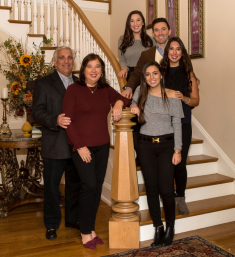
The Maidas also have a long tradition of collaborating with the law school as partners and as investors, starting with their initial gift in 2003. Their philanthropy is based on what the law school needs combined with measurable results.
“We go to the law school and say, ‘How can we help? What do you need?’” James says. “One of the great things is that they come to us each year and report back on all the terrific work they’re doing. This is a five-year gift, and we're going to measure it as we go along to make sure it is having the desired effects. For the new bar stipend program, the impact we want is for Rutgers to be a stronger institution and stronger law school.”
Being a stronger law school also ties into Rutgers’ value of serving the common good, says Johanna Bond, dean of Rutgers Law School.
“As New Jersey’s public law school, we are proud to train students who are not only passionate about their own futures but compassionate about their contributions to the greater good,” Bond says. “Financial support can significantly help students studying for the bar exam. By not needing to work additional hours to cover basic living expenses, students can dedicate more time to studying and fully focus.”
While some law students may go on to high-paying careers, many serve as public defenders and prosecutors. Law is one of those areas “where you can head off in one of many directions,” James says. When it comes to Rutgers law students, he and Sharon ask how the various disciplines within the field of law play together to make the next community of lawyers to create a good well-rounded group.
“When we talk about bar stipends and increasing the scholarships, we ask, ‘How does it help Rutgers at large?’” he says. “We want to help those individuals and get them to pass the bar so they can go do something. We have a friend whose son became an immigration lawyer because he was worried about immigration. There’s a lot of these stories where people want to right a wrong in the world.”
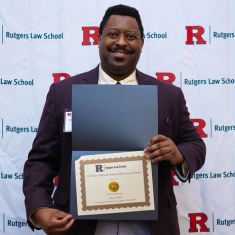
Kerry Robinson, a third-year law student at Camden, had a career in housing before attending Rutgers. The Tuscaloosa, Alabama native who attended Swarthmore College for his bachelor’s degree, was attracted to Rutgers because of its robust pro bono program that is attuned to housing justice issues. Thanks to the Maida Fellows program, he was able to delve more deeply into an area of law he was interested in, while receiving financial support in the summer of 2023 for a position that would normally be unpaid and unavailable to first-year law students.
Robinson, who also has been a pro bono leader throughout law school in the Volunteer Income Tax Assistance and Judith H. Wizmur Bankruptcy Pro Bono Projects, plans to continue his work at Regional Housing Legal Services in Philadelphia after graduation. He credits his Maida Fellowship with helping him stay on the path to a meaningful career where he can work toward more affordable housing.
“I've really gained a broad view of what it means to work in housing law here, from eviction prevention to tenant advocacy to affordable housing development,” Robinson says.
Support Students
Consider a gift to support Rutgers Law Students.