For nearly 30 years, Creighton Drury has used his basketball skills from his days as a Scarlet Knight to help young people overcome challenges and pursue their dreams, expanding opportunities for quality education, housing, careers, and beyond. He will be inducted into the Rutgers Hall of Distinguished Alumni on April 23.
Creighton Drury has built his life around a simple mantra.
“What I learned at Rutgers was something I came to believe in,” he says. “My freshman year, when we were headed to the NCAA tournament, Coach Bob Wenzel exclaimed, ‘This is about dreaming big dreams.’ I came to really believe in that—dreaming big dreams and that anything’s possible.”
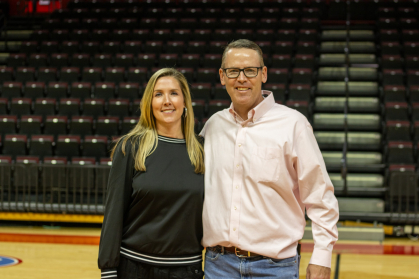
Lauren Sisler CC’06, a sideline reporter for ESPN, and Drury are popular alumni speakers with student-athletes.
From serving as co-captain of the Rutgers 1991-92 basketball team in his senior year to leading highly regarded local and national social impact organizations, he has always followed that mantra with passion and purpose.
Drury serves as CEO of the Partnership to End Addiction, a prominent national nonprofit organization seeking to end the addiction crisis by addressing it early during the critical teenage years. He also participates on the leadership council for the Rutgers Addiction Research Center at the Rutgers Brain Health Institute and he speaks regularly with young people about promoting mental health and building resilience.
Previously, he served as the chief executive for Covenant House New York and senior vice president for Covenant House International, organizations dedicated to providing young people experiencing homelessness with skills and opportunities to overcome challenges and build bright futures.
Drury, a freshman, in the 1989 Rutgers home game against West Virginia
These leadership roles were shaped in part, he says, by his time on the court at the RAC (now Jersey Mike’s Arena). As he sees it, his job— whether trying to win a game or help young people succeed—has been to build and lead teams that work well together.
“As a point guard and captain, I didn’t score much—my role was to find guys with the hot hand and who could score,” says Drury, who stands 6 feet, 4 inches tall. “I knew how to get the ball to the right guys at the right time, play great defense, and inject some positive energy to make a difference in the flow of the game.”
And in many ways, that is exactly what he does now: working with organizations where he has been able to bring together some of the most talented experts in the field with as much passion for the issues as he has, to articulate a shared vision and set of goals, and to selflessly work toward these goals—“in a sense," he says, he is “getting ‘the ball’ to my colleagues, just as with my teammates at Rutgers.”
Hoop Dreams
Drury grew up in River Edge in Bergen County, New Jersey, the son of parents who lived to serve others. His father was a social worker and executive of a nonprofit organization serving youth, and his mother was a nurse.
“Their example and values they instilled in me, I see in my life, personally and through my vocation and work, every single day,” he says.
Though Rutgers wasn’t initially on his radar, he was unexpectedly drawn to the basketball program with the hiring of Coach Wenzel and the potential to earn quality playing time. When he arrived at Rutgers, he thought mostly about his dreams in terms of basketball, because he and his teammates were inspired and encouraged to dream big dreams.
“At first it felt like a slogan, but slowly but surely, we found ourselves on a memorable winning streak, one in which I was playing a lot,” he says. “The team chemistry was amazing. That run led to upsetting Temple in the conference tournament semifinals and coming back to the RAC for what is still a top ten moment in Rutgers’ sports lore—beating Penn State for the championship.”
That team in 1988-89 finished 18-13 and won the Atlantic 10 tournament title, earning a bid to the NCAA Tournament.
In the following off season, however, he experienced a serious back injury, causing him to red shirt and sit out his sophomore year. He returned his junior and senior seasons, playing on and contributing to successful teams, but his injury had taken a toll, requiring more time on the training table and making it increasingly difficult to play.
By his senior year, Drury began to view basketball in a way other than just “I’m going to go out and try to win the game” and started thinking more critically about his place in the world and what he might want to contribute after college.
He followed his adviser’s advice to write his honors thesis on a topic he was passionate about, combining history and basketball in “The Black Athlete in College Basketball,” which earned highest honors.
“My Henry Rutgers thesis was a catalyst in developing a frame for how to look at the world and my place in it,” says Drury, who double majored in political science and history. “For the first time, basketball was a lens, not just for competing on the court, but for how to think about and address what was happening in society. It examined, through historical perspective, disparities for Black athletes, especially those in revenue-earning sports like basketball.”
And that’s when Drury realized basketball wasn’t just a dream, it was a vehicle to identify and pursue other dreams as well.
“Dreams sometimes evolve,” he says, “and that's a good thing.”
Following His Heart
After graduating from Rutgers in 1992, he worked for U.S. Senator Bill Bradley, a former NBA champion with the New York Knicks.
“Senator Bradley was thoughtful on racial issues and investing in communities needing more resources for housing and education,” he says. “Working for him for two years, I had a front-row seat to somebody who was trying to make a difference.”
After earning his degree from the University of Virginia School of Law in 1997, he practiced at Lowenstein Sandler, a prominent New Jersey firm, taking on civil rights cases, one of which involved educational equity for New Jersey students. While his cases were compelling, he came to realize he didn’t want to spend his career litigating.
“I didn’t want to be arguing all the time—I wanted to be involved in the actual creating, and I felt this draw to work more directly with young people and in schools,” he says. “After a lot of discernment and following that inner voice and calling, like basketball had been a calling to me growing up, I made the life-changing decision to leave my law practice.”
Drury moved to live and work in Paterson, New Jersey to help a friend who had founded a nonprofit called New Jersey Community Development Corporation (NJCDC), a social impact organization committed to creating opportunities to transform lives and communities. That move marked the beginning of what became a more than 25-year career in nonprofit organizations “focused primarily on helping young people get opportunities in education and housing, and in life.”
“I want to make sure every kid in this country has a chance to dream their dreams and live their fullest lives—to develop resilience and to benefit from resources and people to help them to do that,” Drury says. “This work has been possible because of what I experienced at Rutgers. My coaches, teammates, professors, and mentors instilled in me a confidence and strong sense of belonging that have allowed me to pursue my dreams.”
In part because of Drury’s efforts, NJCDC now serves more than 4,000 young people each day and has raised more than $100 million to build schools, housing, and community centers in Paterson.
Drury with his wife, Maria, son Gabe, 16, and daughters (right) Laila, 13, and Emilia, 11, whom he calls the most important people in his life
Drury also led statewide gang prevention efforts for two New Jersey governors before becoming executive director of Covenant House New York, where he led one of the nation’s leading youth-serving organizations while also spearheading transformative plans that led to a state-of-the-art program facility for at-risk young people in midtown Manhattan.
In 2018, he became CEO of Partnership to End Addiction, which he says was the nation’s leading think tank that “wanted to become a ‘do’ tank—they wanted to put their years of research into action to help kids and families directly.”
“I had come to understand the impact of substance use and mental health as a barrier to healthy youth development, so I was immediately drawn to this opportunity,” he says. “Along with a remarkable team, we have built a powerhouse that is now reaching and equipping millions of families and thousands of professionals each year with resources, tools, and services based in research, designed to promote healthy youth development while addressing challenges with substance use and mental health.”
The heart of Partnership to End Addiction’s approach centers on understanding adolescent brain development, which is why he was particularly excited to be invited to the leadership council for the Rutgers Addiction Research Center. Part of the Brain Health Institute, it is the largest comprehensive addiction research center in the country.
It’s full circle, he says, being part of this endeavor that “not surprisingly, my alma mater Rutgers is on the forefront of leading,” and being able to collaborate with the work he’s doing right now.
“If you can support young people and address substance use and mental health challenges early on, you’re helping set them up for a lifetime of success,” he says. “When we make the strides I expect over the next five years, to equip millions more caring adults with trusted tools and resources, we’re going to do a lot to reduce rates of addiction, and ultimately that’s going to lead to many lives saved, to more people living healthy lives, and ultimately to millions more young people thriving and pursuing their dreams.”
Nominator’s Remarks
“Creighton Drury’s career has been defined by visionary leadership, moral courage, and measurable impact. He has built institutions, shaped practice and policy, and delivered hope and opportunity to hundreds of thousands—especially in New Jersey. His unwavering dedication to Rutgers and to advancing the common good makes him a truly outstanding and deeply deserving candidate for the Rutgers University Hall of Distinguished Alumni.” —Kevin Rigby RC’76, former State Director/Chief of Staff for U.S. Senator Bill Bradley and former head of North America Public Affairs, Novartis
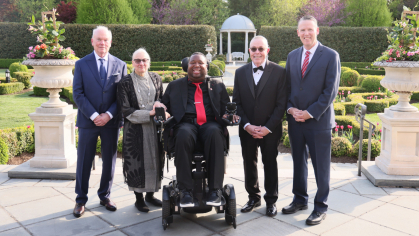
Creighton Drury is one of five inductees who will be formally inducted into the Rutgers Hall of Distinguished Alumni in a ceremony starting at 5:30 p.m. Thursday, April 23, at Park Chateau Estates & Gardens, 678 Cranbury Road, East Brunswick, New Jersey. For more information, visit the Hall of Distinguished Alumni page.
Support Excellence
Consider a gift to the Scarlet Promise Initiative funds.