Opening Doors for Graduate Researchers
An alumnus developing blockbuster drug treatments gives back to Rutgers and honors his former professor.
It was the moment Dinesh Patel had been waiting for.
The 22-year-old with a knack for organic chemistry was leaving his home in India for Ph.D. studies at Rutgers University.
But when his flight landed at John F. Kennedy International Airport, Patel realized he didn’t have enough cash to get to New Brunswick.
“I had $8 in my pocket,” he says. “I was feeling a bit panicky.”
Patel walked through the airport and was stunned to see someone with a sign bearing his name. Martha Cotter, a professor who oversaw the graduate program in the Department of Chemistry and Chemical Biology (CCB), had come to pick him up.
“I can’t describe what a relief it was!” Patel says. “I was just so delighted to see her standing there.”
That was August 1979. Much has changed for Patel since arriving as a cash-strapped graduate student.
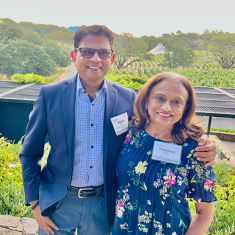
Today, he runs a multibillion-dollar biopharmaceutical firm, Protagonist Therapeutics, that is developing new treatments for illnesses including inflammatory bowel disease, psoriasis, and a rare blood cancer.
He’s a noted figure in the biotech world, excelling as both a scientist and CEO.
But his Rutgers days are still very much on his mind. And he’s found a novel way to give back to the university.
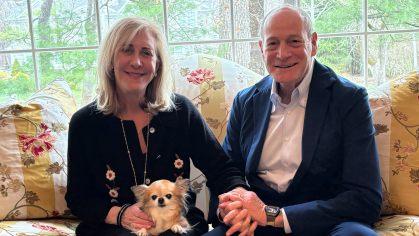
Patel and his wife, Rajeshvari, who also completed graduate studies in chemistry at Rutgers, have established a fellowship that supports CCB students while honoring the faculty member who made Patel’s Rutgers experience so vital.
In the fall of 1979, not long after the warm welcome at JFK, Patel attended a presentation by Spencer Knapp, a relatively new member of the CCB faculty specializing in organic chemistry and drug design. Knapp was only a few minutes into his talk when Patel was hooked.
“My friends are teasing me and saying, ‘You’re going to work with this guy, right?’’’ Patel says. “I was like, ‘Yeah, absolutely.’
“I joined his lab, and that’s probably the best decision I ended up making in college.”
In the Knapp lab, Patel found his calling—medicinal chemistry—and a teacher who was both a leading scholar in the field and a mentor committed to training young scientists to improve human health through organic chemistry.
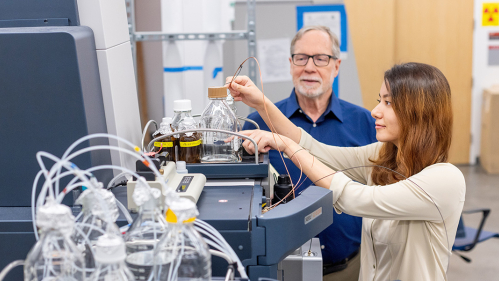
Knapp, a School of Arts and Sciences professor now in his 48th year at Rutgers, has mentored more than 200 students, often collaborating with them on research and journal articles. His research has expanded the understanding of numerous illnesses, from Alzheimer’s Disease to malaria, to various inflammatory conditions.
Accordingly, the Dinesh and Rajeshvari Patel Endowed Graduate Fellowship provides financial support to CCB students conducting organic chemistry research in the Knapp lab.
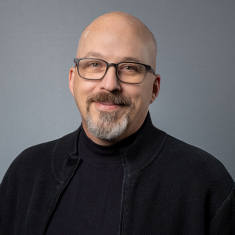
It’s a powerful acknowledgment of Knapp’s influence as well as a testament to faculty mentors, says Lawrence Williams, chair of CCB in the School of Arts and Sciences.
“Spencer creates the environment where people like Dinesh can really excel, and that’s why Dinesh did this,” Williams says. “They didn’t give it to the department to hand out to whoever we want.
“They recognized that the success is traceable to being in that environment, and that it’s the relationship that made it work.”
Knapp, known for his affable nature and for his teaching and research, modestly downplayed his role.
“If I’ve had any success mentoring graduate students, it’s because they arrive so motivated,” Knapp says. “Dinesh would typify that.
“He was incredibly poised as a 22-year-old and always knew the right thing to do at the right time.”
For Knapp, the fellowship is particularly welcome at a time of sweeping federal cuts to science research.
“In the current climate, graduate support on research grants is in danger,” Knapp says. “There are very few fellowships available, especially to immigrant students. Something like Dinesh’s support comes in an era where we have almost nothing.”
The Patels, for their part, noted that each received a graduate assistantship at Rutgers that helped defray their education costs.
“We can never forget the extent to which we benefited from the support we received at Rutgers,” says Dinesh, who received his Ph.D. in 1984. “It will be so satisfying for us to see the future students from the U.S. and all across the globe benefit in the same way we did.”
Rajeshvari agreed.
“We want this scholarship to ease the financial burden for deserving graduate students, allowing them to focus on their research, studies, and professional growth,” says Rajeshvari, who received her master’s degree from Rutgers in 1985.
Both Dinesh and Rajeshvari grew up in India. They were close friends and top chemistry students. And they were shaped by strikingly different family backgrounds. The couple married in 1981 in the United States.
Rajeshvari is the granddaughter of the late Shri Tribhuvandas Patel, an Indian independence activist and follower of Mahatma Gandhi. In 1946, he famously organized milk producers into a cooperative AMUL, India's largest dairy cooperative, that protected small dairy farmers against large conglomerates, and which continues to this day as the world’s largest cooperative.
“His vision was simple but transformative: that ordinary farmers, when united, could achieve extraordinary strength and dignity,” Rajeshvari says. “For me, it is a compass for life.”
She has carried that compass through a career that included top scientific roles in firms such as Novartis and Bristol Myers Squibb.
“I have always believed that science is not just about discovery in the lab, but about translating that discovery into real-world impact that improves people’s health,” she says.
Dinesh, meanwhile, grew up fascinated by science and medicine while also harboring an irrepressible creative impulse that he longed to channel into a calling. His parents, who were farmers, encouraged him to get an education and find a career.
“There were very clear instructions that getting out of the village, getting an education, and getting a job is what you have to do,” he says.
But after earning his Ph.D. and working his way up the ladder at Bristol Myers Squibb, Patel began charting his own course. He moved to the Bay Area in the 1990s and co-founded two companies, including Vicuron, which was later acquired by Pfizer for $1.9 billion.
“Creativity comes in different forms, and at the end of the day, I realized I am an entrepreneur,” he says. “I thrive on solving problems amid uncertainty.”
In 2008, with the Great Recession taking hold, Patel shifted gears and took a job as CEO of Protagonist, then a much smaller company based in Australia. It would prove to be his boldest creative act yet. He expanded the company, moved it to the U.S., and developed a pipeline of potential drugs.
Unlike other such treatments, the medications could be taken orally rather than by injection, thanks to a new technology developed by Patel and his team that uses peptides rather than small molecules or large antibodies.
“I put all my chemistry know-how into place, and then that crazy entrepreneurial, high-risk mindset kicks in,” he says. “And that was the whole journey.”
With its impressive array of treatments, Protagonist has enjoyed lucrative partnerships with Big Pharma, including Johnson & Johnson and Takeda. The company now has a market capitalization of over $5 billion.
Impressive as all that might seem, Patel stressed, it’s all traceable back to a Rutgers lab.
“It might seem like this magic formularization,” he says. “But the whole company is based on innovation and invention, and the core roots of that could be found in the training I had at Rutgers, and specifically under Spencer Knapp.”
Support Students
Consider a gift to support Chemistry and Chemical Biology students in the Rutgers–New Brunswick School of Arts and Sciences.